
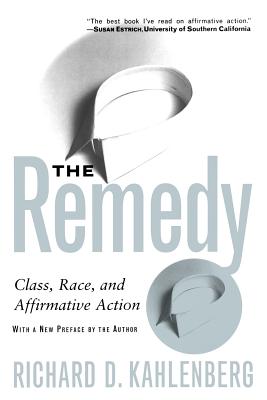
The Remedy: Class, Race, and Affirmative Action
| AUTHOR | Kahlenberg, Richard D. |
| PUBLISHER | Basic Books (05/16/1997) |
| PRODUCT TYPE | Paperback (Paperback) |
Description
In this provocative and paradigm-shifting book, Richard D. Kahlenberg argues that affirmative action programs ought to be based not on race but on class. America's exclusive focus on race in determining how to allocate economic and educational opportunities has served only to undermine the moral legitimacy of affirmative action, the results clearly visible in the growing public sentiment to abolish such programs.Kahlenberg shows that it is time to return to affirmative action's roots, so that it works to the benefit of the truly disadvantaged, regardless of race. In a sweeping and damning analysis, Kahlenberg examines how the rationale for affirmative action has moved inexorably away from its original commitment to remedy past discrimination and instead has become a means to achieve racial diversity, even if that means giving preference to upper-middle-class blacks over poor whites. He outlines how a class-based system of affirmative action would work, why all Americans should embrace it, and how the African-American community in particular would continue to reap the benefits it needs without engendering resentment among whites.
Show More
Product Format
Product Details
ISBN-13:
9780465098248
ISBN-10:
046509824X
Binding:
Paperback or Softback (Trade Paperback (Us))
Content Language:
English
More Product Details
Page Count:
384
Carton Quantity:
16
Product Dimensions:
6.00 x 1.40 x 9.00 inches
Weight:
0.88 pound(s)
Feature Codes:
Bibliography,
Index,
Price on Product
Country of Origin:
US
Subject Information
BISAC Categories
Social Science | Minority Studies
Social Science | General
Social Science | Sociology - General
Accelerated Reader:
Reading Level:
0
Point Value:
0
Guided Reading Level:
Not Applicable
Dewey Decimal:
342.087
Descriptions, Reviews, Etc.
annotation
A Fellow of the Center for National Policy, Richard D. Kahlenberg argues that affirmative action programs ought to be based not on race but on class. Kahlenberg outlines how a class-based system of affirmative action would work. He shows that it is time to return to affirmative action's roots, so that it works to the benefit of the truly disadvantaged, regardless of race.
Show More
publisher marketing
In this provocative and paradigm-shifting book, Richard D. Kahlenberg argues that affirmative action programs ought to be based not on race but on class. America's exclusive focus on race in determining how to allocate economic and educational opportunities has served only to undermine the moral legitimacy of affirmative action, the results clearly visible in the growing public sentiment to abolish such programs.Kahlenberg shows that it is time to return to affirmative action's roots, so that it works to the benefit of the truly disadvantaged, regardless of race. In a sweeping and damning analysis, Kahlenberg examines how the rationale for affirmative action has moved inexorably away from its original commitment to remedy past discrimination and instead has become a means to achieve racial diversity, even if that means giving preference to upper-middle-class blacks over poor whites. He outlines how a class-based system of affirmative action would work, why all Americans should embrace it, and how the African-American community in particular would continue to reap the benefits it needs without engendering resentment among whites.
Show More
Author:
Kahlenberg, Richard D.
Richard D. Kahlenberg is a senior fellow at The Century Foundation, where he writes about education, equal opportunity, and civil rights. He is the author of four books, including Tough Liberal: Albert Shanker and the Battles Over Schools, Unions, Race, and Democracy (Columbia University Press, 2007) and All Together Now: Creating Middle-Class Schools through Public School Choice (a Century Foundation Book published by Brookings, 2001). He is also the editor of four more, including America's Untapped Resource: Low-Income Students in Higher Education (Century Foundation Press, 2004) and Public School Choice vs. Private School Vouchers (Century Foundation Press, 2003).
Show More
Your Price
$21.77