
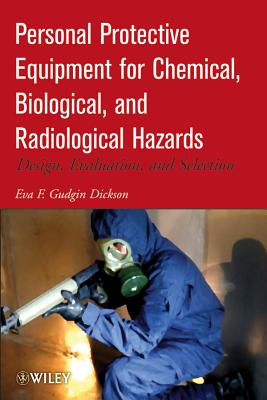
Personal Protective Equipment for Chemical, Biological, and Radiological Hazards: Design, Evaluation, and Selection
| AUTHOR | Gudgin Dickson, Eva F. |
| PUBLISHER | Wiley (10/23/2012) |
| PRODUCT TYPE | Hardcover (Hardcover) |
Personal protective equipment (PPE) is critical for those dealing with toxic, infectious, and radioactive materials. An easily accessible guide for professionals and researchers in all PPE fields, this book takes a fresh look at how PPE is designed, selected, and used in today's emergency response environment where users may need to be protected against deliberately used chemical, biological, or radiological agents in terrorism or warfare scenarios as well as more traditional hazards. Covering the physics, chemistry, and physiology of these hazards, the book explains how PPE protects from various forms of hazards as well as how to use this information to select PPE against these highly hazardous substances for first responder or military users. The design of PPE and components plus relevant performance and evaluation standards are also discussed.
Enables readers to understand how personal protective equipment is designed, evaluated, and selected to meet specific goals
Personal protective equipment is critical for anyone who may come in contact with health- and life-threatening chemical, biological, radiological, or nuclear agents. This book sets forth the underlying physics, chemistry, and physiology of these hazards and then explains how personal protective equipment is designed to protect individuals from contamination. Readers will discover how personal protective equipment is assessed and evaluated to ensure its safety and effectiveness, including examples of standard testing methods. Finally, the author offers principles to guide the selection and use of personal protective equipment in order to safeguard individuals from specific hazards.
Personal Protective Equipment for Chemical, Biological, and Radiological Hazards begins with a review of chemical, biological, radiological, and nuclear agents and the need for personal protective equipment. Next, the book examines:
- Hazardous substances
- Setting high-level requirements
- Designing for appropriate protection and performance
- Protective equipment: concepts, components, and systems
- Performance evaluation and standard test methods
- Selection and use of personal protective equipment
Throughout the book, the author provides examples of available personal protective equipment and explores emerging concepts that are driving new research and product development. In addition, readers will find a listing and review of current standards governing personal protective equipment.
With this comprehensive review as their guide, readers will understand how personal protective equipment is designed and evaluated. Moreover, they'll know how to select personal protective equipment to protect themselves and others from a broad range of specific threats.
Personal protective equipment (PPE) is critical for those dealing with toxic, infectious, and radioactive materials. An easily accessible guide for professionals and researchers in all PPE fields, this book takes a fresh look at how PPE is designed, selected, and used in today's emergency response environment where users may need to be protected against deliberately used chemical, biological, or radiological agents in terrorism or warfare scenarios as well as more traditional hazards. Covering the physics, chemistry, and physiology of these hazards, the book explains how PPE protects from various forms of hazards as well as how to use this information to select PPE against these highly hazardous substances for first responder or military users. The design of PPE and components plus relevant performance and evaluation standards are also discussed.