
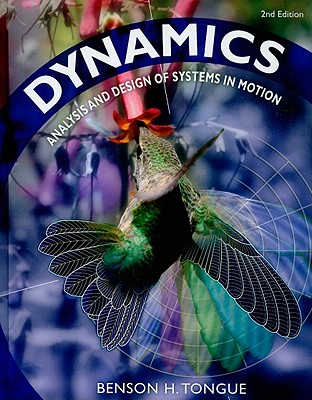
Dynamics: Analysis and Design of Systems in Motion
| AUTHOR | Tongue, Benson H. |
| PUBLISHER | Wiley (10/01/2009) |
| PRODUCT TYPE | Hardcover (Hardcover) |
Engineering Mechanics: Dynamics, 2nd Edition provides engineers with a conceptual understanding of how dynamics is applied in the field. This edition offers a student-focused approach to Dynamics with new problems and images that develop problem solving skills. Engineers will benefit from the numerous worked problems, algorithmic problems and multi-part GO problems. Additional images have been added, showing a link between an actual system and a modeled/analyzed system. The importance of communicating solutions through graphics is continuously emphasized with a focus on drawing correct free body diagrams and inertial response diagrams.
WileyPLUS is sold separately from this text.
Engineering Mechanics: Dynamics, 2nd Edition provides engineers with a conceptual understanding of how dynamics is applied in the field. This edition offers a student-focused approach to Dynamics with new problems and images that develop problem solving skills. Engineers will benefit from the numerous worked problems, algorithmic problems and multi-part GO problems. Additional images have been added, showing a link between an actual system and a modeled/analyzed system. The importance of communicating solutions through graphics is continuously emphasized with a focus on drawing correct free body diagrams and inertial response diagrams.
WileyPLUS is sold separately from this text.
Dr. Sheppard was recently named co-principal investigator on a NSF grant to form the Center for the Advancement of Engineering Education (CAEE), along with faculty at the University of Washington, Colorado School of Mines, and Howard University. She was co-principal investigator with Professor Larry Leifer on a multi-university NSF grant that was critically looking at engineering undergraduate curriculum (Synthesis). In 1999, Sheri was named a fellow of the American Society of Mechanical Engineering(ASME) and the American Association for the Advancement of Science (AAAS). Recently Sheri was awarded the 20 04 ASEE Chester F. Carlson Award in recognition of distinguished accomplishments in engineering education. Before coming to Stanford University, she held several positions in the automotive industry, including senior research engineering at Ford Motor Company's Scientific Research Lab. She also worked as a design consultant, providing companies with structural analysis expertise.
Benson H. Tongue, Ph.D. is a Professor of Mechanical Engineering at University of California-Berkeley. He received his Ph.D. from Princeton University in1988, and Currently teaches graduate and undergraduate courses in dynamics vibrations, and control theory. His research concentrates on the modeling and analysis of nonlinear dynamical systems and the control of both structural and acoustic systems. This work involves experimental, theoretical, and numerical analysis and has been directed toward helicopters, computer disk drives, robotic manipulators, and general structural systems. Most recently, he has been involved in a multidisciplinary stud of automated highways and has directed research aimed at understanding the nonlinear behavior of vehicles traveling in platoons and in devising controllers that optimize the platoon's behavior in the face of non-nominal operating conditions. His most recent research has involved in the active control of loudspeakers and biomechanical analysis of human fall dynamics.
Dr. Tongue is the author of Principles of Vibration, a senior/first-year graduate-level textbook. He has served as Associate Technical Editor of the ASME Journal of Vibration and Acoustics and is currently a member of the ASME Committee on Dynamics of Structures and Systems. He is the recipient of the NSF Presidential Young Investigator Award, the Sigma Xi Junior Faculty award, and the Pi Tau Sigma Excellence in Teaching award. He serves as a reviewer for numerous journals and funding agencies and is the author of more than sixty publications.