
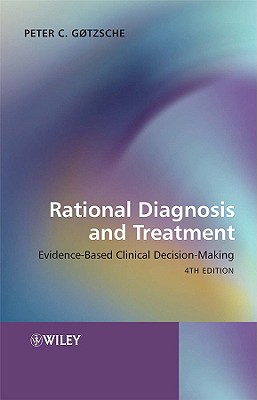
Rational Diagnosis and Treatment: Evidence-Based Clinical Decision-Making
| AUTHOR | Gtzsche, Peter; Gtzsche, Peter; Gotzsche, Peter |
| PUBLISHER | Wiley-Interscience (01/01/2008) |
| PRODUCT TYPE | Hardcover (Hardcover) |
Now in its fourth edition, Rational Diagnosis and Treatment: Evidence-Based Clinical Decision-Making is a unique book to look at evidence-based medicine and the difficulty of applying evidence from group studies to individual patients.
The book analyses the successive stages of the decision process and deals with topics such as the examination of the patient, the reliability of clinical data, the logic of diagnosis, the fallacies of uncontrolled therapeutic experience and the need for randomised clinical trials and meta-analyses. It is the main theme of the book that, whenever possible, clinical decisions must be based on the evidence from clinical research, but the authors also explain the pitfalls of such research and the problems involved in applying evidence from groups of patients to the individual patient.
For this new edition, the sections on placebo and meta-analysis and on alternative medicine have been thoroughly updated, and there is more focus on insufficient reporting of harms of interventions. The sections on different research designs describe advantages and limitations, and the increased medicalisation and the effects of cancer screening on health people are noted. A section on academic freedom when clinicians collaborate with industry and ghost authors is added.
This essential reference work integrates the science and statistical approach of evidence-based medicine with the art and humanism of medical practice; distinguishing between data, sets of data, knowledge and wisdom, and their application. Such an intellectually challenging book is ideal for both medical students and doctors who require theoretical and practical clinical skills to help ensure that they apply theory in practice.
This fourth edition of Peter Gotzsche's Rational Diagnosis and Treatment argues that clinical decision-making should be built from first principles. By asking relevant questions, such as 'how reliable are various sorts of data?' 'how has the disease classification evolved over time, and is it logical?', fewer mistakes will be made by the practising physician and trainee.
This beautifully written book integrates the science and statistical approach of evidence-based medicine with the art and humanism of medical practice. It stresses that, whenever possible, clinical decisions must be based on the best evidence from clinical research; but also highlights the pitfalls of such research and the problems involved in applying evidence from groups of patients to the individual patient.
Such an intellectually challenging book is ideal for medical students, practitioners and doctors who require theoretical and practical clinical skills to help ensure that they apply theory to their practice, to achieve the best possible outcomes.
- How does the diagnostic process narrow down options, and what are the pitfalls in diagnostic reasoning?
- How do randomness, the spontaneous course of the disease, the placebo effect, luck and clinical trials come together?
- What is the nature of reasoning?
- What is the true value of the published literature?
- How do commercial interests distort our perceptions about drugs?
- Should people get screened for cancer and other diseases?
New edition contains:
- Updated sections on placebo and meta-analysis
- Sections on different research designs, focusing on advantages and limitations
- Notes on increased medicalisation and the effects of cancer screening on healthy people
- Updated section on alternative medicine
- Greater focus on insufficient reporting of harms of interventions
- Additional text on academic freedom
Now in its fourth edition, Rational Diagnosis and Treatment: Evidence-Based Clinical Decision-Making is a unique book to look at evidence-based medicine and the difficulty of applying evidence from group studies to individual patients.
The book analyses the successive stages of the decision process and deals with topics such as the examination of the patient, the reliability of clinical data, the logic of diagnosis, the fallacies of uncontrolled therapeutic experience and the need for randomised clinical trials and meta-analyses. It is the main theme of the book that, whenever possible, clinical decisions must be based on the evidence from clinical research, but the authors also explain the pitfalls of such research and the problems involved in applying evidence from groups of patients to the individual patient.
For this new edition, the sections on placebo and meta-analysis and on alternative medicine have been thoroughly updated, and there is more focus on insufficient reporting of harms of interventions. The sections on different research designs describe advantages and limitations, and the increased medicalisation and the effects of cancer screening on health people are noted. A section on academic freedom when clinicians collaborate with industry and ghost authors is added.
This essential reference work integrates the science and statistical approach of evidence-based medicine with the art and humanism of medical practice; distinguishing between data, sets of data, knowledge and wisdom, and their application. Such an intellectually challenging book is ideal for both medical students and doctors who require theoretical and practical clinical skills to help ensure that they apply theory in practice.