
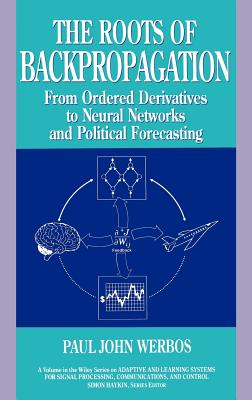
The Roots of Backpropagation: From Ordered Derivatives to Neural Networks and Political Forecasting
| AUTHOR | Werbos, Paul John; Werbos; Werbos, Paul John et al. |
| PUBLISHER | Wiley-Interscience (03/31/1994) |
| PRODUCT TYPE | Hardcover (Hardcover) |
Description
Now, for the first time, publication of the landmark work inbackpropagation! Scientists, engineers, statisticians, operationsresearchers, and other investigators involved in neural networkshave long sought direct access to Paul Werbos's groundbreaking, much-cited 1974 Harvard doctoral thesis, The Roots ofBackpropagation, which laid the foundation of backpropagation. Now, with the publication of its full text, these practitioners can gostraight to the original material and gain a deeper, practicalunderstanding of this unique mathematical approach to socialstudies and related fields. In addition, Werbos has provided threemore recent research papers, which were inspired by his originalwork, and a new guide to the field. Originally written for readerswho lacked any knowledge of neural nets, The Roots ofBackpropagation firmly established both its historical andcontinuing significance as it:
* Demonstrates the ongoing value and new potential ofbackpropagation
* Creates a wealth of sound mathematical tools useful acrossdisciplines
* Sets the stage for the emerging area of fast automaticdifferentiation
* Describes new designs for forecasting and control which exploitbackpropagation
* Unifies concepts from Freud, Jung, biologists, and others into anew mathematical picture of the human mind and how it works
* Certifies the viability of Deutsch's model of nationalism as apredictive tool--as well as the utility of extensions of thiscentral paradigm
"What a delight it was to see Paul Werbos rediscover Freud'sversion of 'back-propagation.' Freud was adamant (in The Projectfor a Scientific Psychology) that selective learning could onlytake place if the presynaptic neuron was as influenced as is thepostsynaptic neuron during excitation. Such activation of bothsides of the contact barrier (Freud's name for the synapse) wasaccomplished by reducing synaptic resistance by the absorption of'energy' at the synaptic membranes. Not bad for 1895! But Werbos1993 is even better." --Karl H. Pribram Professor Emeritus, Stanford University
* Demonstrates the ongoing value and new potential ofbackpropagation
* Creates a wealth of sound mathematical tools useful acrossdisciplines
* Sets the stage for the emerging area of fast automaticdifferentiation
* Describes new designs for forecasting and control which exploitbackpropagation
* Unifies concepts from Freud, Jung, biologists, and others into anew mathematical picture of the human mind and how it works
* Certifies the viability of Deutsch's model of nationalism as apredictive tool--as well as the utility of extensions of thiscentral paradigm
"What a delight it was to see Paul Werbos rediscover Freud'sversion of 'back-propagation.' Freud was adamant (in The Projectfor a Scientific Psychology) that selective learning could onlytake place if the presynaptic neuron was as influenced as is thepostsynaptic neuron during excitation. Such activation of bothsides of the contact barrier (Freud's name for the synapse) wasaccomplished by reducing synaptic resistance by the absorption of'energy' at the synaptic membranes. Not bad for 1895! But Werbos1993 is even better." --Karl H. Pribram Professor Emeritus, Stanford University
Show More
Product Format
Product Details
ISBN-13:
9780471598978
ISBN-10:
0471598976
Binding:
Hardback or Cased Book (Sewn)
Content Language:
English
More Product Details
Page Count:
336
Carton Quantity:
26
Product Dimensions:
6.49 x 0.99 x 9.52 inches
Weight:
1.40 pound(s)
Feature Codes:
Bibliography,
Index,
Illustrated
Country of Origin:
US
Subject Information
BISAC Categories
Computers | Data Science - Neural Networks
Computers | Networking - General
Computers | Cybernetics
Dewey Decimal:
003.5
Library of Congress Control Number:
93023159
Descriptions, Reviews, Etc.
jacket back
Now, for the first time, publication of the landmark work in backpropagation! Scientists, engineers, statisticians, operations researchers, and other investigators involved in neural networks have long sought direct access to Paul Werbos's groundbreaking, much-cited 1974 Harvard doctoral thesis, The Roots of Backpropagation, which laid the foundation of backpropagation. Now, with the publication of its full text, these practitioners can go straight to the original material and gain a deeper, practical understanding of this unique mathematical approach to social studies and related fields. In addition, Werbos has provided three more recent research papers, which were inspired by his original work, and a new guide to the field. Originally written for readers who lacked any knowledge of neural nets, The Roots of Backpropagation firmly established both its historical and continuing significance as it:
- Demonstrates the ongoing value and new potential of backpropagation
- Creates a wealth of sound mathematical tools useful across disciplines
- Sets the stage for the emerging area of fast automatic differentiation
- Describes new designs for forecasting and control which exploit backpropagation
- Unifies concepts from Freud, Jung, biologists, and others into a new mathematical picture of the human mind and how it works
- Certifies the viability of Deutsch's model of nationalism as a predictive tool--as well as the utility of extensions of this central paradigm
Show More
publisher marketing
Now, for the first time, publication of the landmark work inbackpropagation! Scientists, engineers, statisticians, operationsresearchers, and other investigators involved in neural networkshave long sought direct access to Paul Werbos's groundbreaking, much-cited 1974 Harvard doctoral thesis, The Roots ofBackpropagation, which laid the foundation of backpropagation. Now, with the publication of its full text, these practitioners can gostraight to the original material and gain a deeper, practicalunderstanding of this unique mathematical approach to socialstudies and related fields. In addition, Werbos has provided threemore recent research papers, which were inspired by his originalwork, and a new guide to the field. Originally written for readerswho lacked any knowledge of neural nets, The Roots ofBackpropagation firmly established both its historical andcontinuing significance as it:
* Demonstrates the ongoing value and new potential ofbackpropagation
* Creates a wealth of sound mathematical tools useful acrossdisciplines
* Sets the stage for the emerging area of fast automaticdifferentiation
* Describes new designs for forecasting and control which exploitbackpropagation
* Unifies concepts from Freud, Jung, biologists, and others into anew mathematical picture of the human mind and how it works
* Certifies the viability of Deutsch's model of nationalism as apredictive tool--as well as the utility of extensions of thiscentral paradigm
"What a delight it was to see Paul Werbos rediscover Freud'sversion of 'back-propagation.' Freud was adamant (in The Projectfor a Scientific Psychology) that selective learning could onlytake place if the presynaptic neuron was as influenced as is thepostsynaptic neuron during excitation. Such activation of bothsides of the contact barrier (Freud's name for the synapse) wasaccomplished by reducing synaptic resistance by the absorption of'energy' at the synaptic membranes. Not bad for 1895! But Werbos1993 is even better." --Karl H. Pribram Professor Emeritus, Stanford University
* Demonstrates the ongoing value and new potential ofbackpropagation
* Creates a wealth of sound mathematical tools useful acrossdisciplines
* Sets the stage for the emerging area of fast automaticdifferentiation
* Describes new designs for forecasting and control which exploitbackpropagation
* Unifies concepts from Freud, Jung, biologists, and others into anew mathematical picture of the human mind and how it works
* Certifies the viability of Deutsch's model of nationalism as apredictive tool--as well as the utility of extensions of thiscentral paradigm
"What a delight it was to see Paul Werbos rediscover Freud'sversion of 'back-propagation.' Freud was adamant (in The Projectfor a Scientific Psychology) that selective learning could onlytake place if the presynaptic neuron was as influenced as is thepostsynaptic neuron during excitation. Such activation of bothsides of the contact barrier (Freud's name for the synapse) wasaccomplished by reducing synaptic resistance by the absorption of'energy' at the synaptic membranes. Not bad for 1895! But Werbos1993 is even better." --Karl H. Pribram Professor Emeritus, Stanford University
Show More
List Price $220.95
Your Price
$218.74