
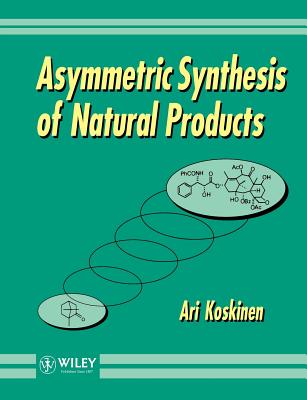
Asymmetric Synthesis of Natural Products
| AUTHOR | Koskinen; Koskinen; Koskinen et al. |
| PUBLISHER | Wiley (08/20/1993) |
| PRODUCT TYPE | Paperback (Paperback) |
Description
Asymmetric Synthesis of Natural Products Ari Koskinen Department of Chemistry, University of Oulu, Finland Natural product synthesis has played a key role in the development of many synthetic methods and will continue to do so in the future. Many recent advances in such diverse fields as immunology, cellular biology and materials science have been achieved through the synthetic chemist's ability to construct often very complicated structures in one enantiomeric form. This book introduces the student to this rapidly growing field of organic chemistry. The first three chapters present the foundations of asymmetric synthesis, with Chapter 3 describing, in concise but clear rationalizations, the reasons for the major asymmetric transformations. Chapters 4 to 10 cover individual classes of natural products; their structures, biosynthesis and interrelationships as well as examples of asymmetric syntheses and the practical value of these compounds.
Show More
Product Format
Product Details
ISBN-13:
9780471938484
ISBN-10:
0471938483
Binding:
Paperback or Softback (Trade Paperback (Us))
Content Language:
English
More Product Details
Page Count:
252
Carton Quantity:
17
Product Dimensions:
7.51 x 0.62 x 9.59 inches
Weight:
1.00 pound(s)
Country of Origin:
GB
Subject Information
BISAC Categories
Science | Chemistry - Organic
Dewey Decimal:
547.704
Library of Congress Control Number:
92043969
Descriptions, Reviews, Etc.
jacket back
Asymmetric Synthesis of Natural Products Ari Koskinen Department of Chemistry, University of Oulu, Finland Natural product synthesis has played a key role in the development of many synthetic methods and will continue to do so in the future. Many recent advances in such diverse fields as immunology, cellular biology and materials science have been achieved through the synthetic chemist's ability to construct often very complicated structures in one enantiomeric form. This book introduces the student to this rapidly growing field of organic chemistry. The first three chapters present the foundations of asymmetric synthesis, with Chapter 3 describing, in concise but clear rationalizations, the reasons for the major asymmetric transformations. Chapters 4 to 10 cover individual classes of natural products; their structures, biosynthesis and interrelationships as well as examples of asymmetric syntheses and the practical value of these compounds.
Show More
Your Price
$203.89