
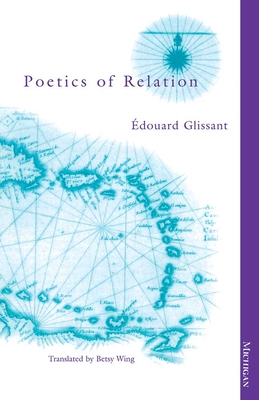
Poetics of Relation
| AUTHOR | Wing, Betsy; Glissant, Edouard |
| PUBLISHER | University of Michigan Press (09/29/1997) |
| PRODUCT TYPE | Paperback (Paperback) |
Description
douard Glissant, long recognized in the French and francophone world as one of the greatest writers and thinkers of our times, is increasingly attracting attention from English-speaking readers. Born in Martinique in 1928, Glissant earned a doctorate from the Sorbonne. When he returned to his native land in the mid-sixties, his writing began to focus on the idea of a "relational poetics," which laid the groundwork for the "crolit" movement, fueled by the understanding that Caribbean culture and identity are the positive products of a complex and multiple set of local historical circumstances. Some of the metaphors of local identity Glissant favored--the hinterland (or lack of it), the maroon (or runaway slave), the creole language--proved lasting and influential.
In Poetics of Relation, Glissant turns the concrete particulars of Caribbean reality into a complex, energetic vision of a world in transformation. He sees the Antilles as enduring suffering imposed by history, yet as a place whose unique interactions will one day produce an emerging global consensus. Arguing that the writer alone can tap the unconscious of a people and apprehend its multiform culture to provide forms of memory capable of transcending "nonhistory," Glissant defines his "poetics of relation"--both aesthetic and political--as a transformative mode of history, capable of enunciating and making concrete a French-Caribbean reality with a self-defined past and future. Glissant's notions of identity as constructed in relation and not in isolation are germane not only to discussions of Caribbean creolization but also to our understanding of U.S. multiculturalism. In Glissant's view, we come to see that relation in all its senses--telling, listening, connecting, and the parallel consciousness of self and surroundings--is the key to transforming mentalities and reshaping societies.
This translation of Glissant's work preserves the resonating quality of his prose and makes the richness and ambiguities of his voice accessible to readers in English.
"The most important theoretician from the Caribbean writing today. . . . He is central not only to the burgeoning field of Caribbean studies, but also to the newly flourishing literary scene in the French West Indies." --Judith Graves Miller, University of Wisconsin, Madison
douard Glissant is Distinguished Professor of French at City University of New York, Graduate Center. Betsy Wing's recent translations include Lucie Aubrac's Outwitting the Gestapo (with Konrad Bieber), Didier Eribon's Michel Foucault and Hlne Cixous's The Book of Promethea.
In Poetics of Relation, Glissant turns the concrete particulars of Caribbean reality into a complex, energetic vision of a world in transformation. He sees the Antilles as enduring suffering imposed by history, yet as a place whose unique interactions will one day produce an emerging global consensus. Arguing that the writer alone can tap the unconscious of a people and apprehend its multiform culture to provide forms of memory capable of transcending "nonhistory," Glissant defines his "poetics of relation"--both aesthetic and political--as a transformative mode of history, capable of enunciating and making concrete a French-Caribbean reality with a self-defined past and future. Glissant's notions of identity as constructed in relation and not in isolation are germane not only to discussions of Caribbean creolization but also to our understanding of U.S. multiculturalism. In Glissant's view, we come to see that relation in all its senses--telling, listening, connecting, and the parallel consciousness of self and surroundings--is the key to transforming mentalities and reshaping societies.
This translation of Glissant's work preserves the resonating quality of his prose and makes the richness and ambiguities of his voice accessible to readers in English.
"The most important theoretician from the Caribbean writing today. . . . He is central not only to the burgeoning field of Caribbean studies, but also to the newly flourishing literary scene in the French West Indies." --Judith Graves Miller, University of Wisconsin, Madison
douard Glissant is Distinguished Professor of French at City University of New York, Graduate Center. Betsy Wing's recent translations include Lucie Aubrac's Outwitting the Gestapo (with Konrad Bieber), Didier Eribon's Michel Foucault and Hlne Cixous's The Book of Promethea.
Show More
Product Format
Product Details
ISBN-13:
9780472066292
ISBN-10:
0472066293
Binding:
Paperback or Softback (Trade Paperback (Us))
Content Language:
English
More Product Details
Page Count:
256
Carton Quantity:
32
Product Dimensions:
5.48 x 0.85 x 8.45 inches
Weight:
0.79 pound(s)
Feature Codes:
Bibliography,
Price on Product
Country of Origin:
US
Subject Information
BISAC Categories
Literary Criticism | Caribbean & Latin American
Literary Criticism | Caribbean & West Indies - General
Literary Criticism | French
Dewey Decimal:
972.982
Library of Congress Control Number:
97006997
Descriptions, Reviews, Etc.
publisher marketing
douard Glissant, long recognized in the French and francophone world as one of the greatest writers and thinkers of our times, is increasingly attracting attention from English-speaking readers. Born in Martinique in 1928, Glissant earned a doctorate from the Sorbonne. When he returned to his native land in the mid-sixties, his writing began to focus on the idea of a "relational poetics," which laid the groundwork for the "crolit" movement, fueled by the understanding that Caribbean culture and identity are the positive products of a complex and multiple set of local historical circumstances. Some of the metaphors of local identity Glissant favored--the hinterland (or lack of it), the maroon (or runaway slave), the creole language--proved lasting and influential.
In Poetics of Relation, Glissant turns the concrete particulars of Caribbean reality into a complex, energetic vision of a world in transformation. He sees the Antilles as enduring suffering imposed by history, yet as a place whose unique interactions will one day produce an emerging global consensus. Arguing that the writer alone can tap the unconscious of a people and apprehend its multiform culture to provide forms of memory capable of transcending "nonhistory," Glissant defines his "poetics of relation"--both aesthetic and political--as a transformative mode of history, capable of enunciating and making concrete a French-Caribbean reality with a self-defined past and future. Glissant's notions of identity as constructed in relation and not in isolation are germane not only to discussions of Caribbean creolization but also to our understanding of U.S. multiculturalism. In Glissant's view, we come to see that relation in all its senses--telling, listening, connecting, and the parallel consciousness of self and surroundings--is the key to transforming mentalities and reshaping societies.
This translation of Glissant's work preserves the resonating quality of his prose and makes the richness and ambiguities of his voice accessible to readers in English.
"The most important theoretician from the Caribbean writing today. . . . He is central not only to the burgeoning field of Caribbean studies, but also to the newly flourishing literary scene in the French West Indies." --Judith Graves Miller, University of Wisconsin, Madison
douard Glissant is Distinguished Professor of French at City University of New York, Graduate Center. Betsy Wing's recent translations include Lucie Aubrac's Outwitting the Gestapo (with Konrad Bieber), Didier Eribon's Michel Foucault and Hlne Cixous's The Book of Promethea.
In Poetics of Relation, Glissant turns the concrete particulars of Caribbean reality into a complex, energetic vision of a world in transformation. He sees the Antilles as enduring suffering imposed by history, yet as a place whose unique interactions will one day produce an emerging global consensus. Arguing that the writer alone can tap the unconscious of a people and apprehend its multiform culture to provide forms of memory capable of transcending "nonhistory," Glissant defines his "poetics of relation"--both aesthetic and political--as a transformative mode of history, capable of enunciating and making concrete a French-Caribbean reality with a self-defined past and future. Glissant's notions of identity as constructed in relation and not in isolation are germane not only to discussions of Caribbean creolization but also to our understanding of U.S. multiculturalism. In Glissant's view, we come to see that relation in all its senses--telling, listening, connecting, and the parallel consciousness of self and surroundings--is the key to transforming mentalities and reshaping societies.
This translation of Glissant's work preserves the resonating quality of his prose and makes the richness and ambiguities of his voice accessible to readers in English.
"The most important theoretician from the Caribbean writing today. . . . He is central not only to the burgeoning field of Caribbean studies, but also to the newly flourishing literary scene in the French West Indies." --Judith Graves Miller, University of Wisconsin, Madison
douard Glissant is Distinguished Professor of French at City University of New York, Graduate Center. Betsy Wing's recent translations include Lucie Aubrac's Outwitting the Gestapo (with Konrad Bieber), Didier Eribon's Michel Foucault and Hlne Cixous's The Book of Promethea.
Show More
Author:
Glissant, Edouard
Born in Martinique in 1928, influenced by poet/politician Aime Cesaire, and educated at the Sorbonne in Paris, Edouard Glissant has emerged as one of the most influential postcolonial theorists, novelists, playwrights, and poets not only in the Caribbean but also in contemporary French literature. He has twice been a finalist for the Nobel Prize in Literature. His works include Poetics of Relation, Caribbean Discourse, Faulkner Mississippi, Collected Poems, and the novel The Ripening. He is currently Distinguished Professor of French at the Graduate Center, CUNY and lives in New York, Paris, and Martinique.
Show More
Your Price
$22.72