
Celtic Art: The Methods of Construction
| AUTHOR | Bain, George |
| PUBLISHER | Dover Publications (06/01/1973) |
| PRODUCT TYPE | Paperback (Paperback) |
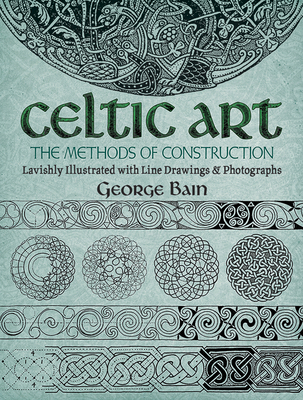
The construction principles of Celtic art were re-discovered in the middle of the 20th century by George Bain. Until his writing, the intricate knots, interlacings, and spirals used in illuminating The Book of Kells and in decorating craftwork and jewelry seemed almost impossible, "the work of angels." In this pioneering work, George Bain shows how simple principles, no more difficult than those used in needlecraft, were used to create some of the finest artistic works ever seen. He also explains how you can use these principles in re-creating artifacts and in creating your own Celtic designs for art and craft work or even for recreational use.
Step-by-step procedures carefully introduce the simple rules and methods of Celtic knot work and the well-known designs from the great manuscripts and stone work. Later chapters build up to complex knot work, spiral work, and key pattern designs, with special coverage of alphabets and the stylized use of animals, humans, and plants. Altogether over 225 different patterns are presented for your use, with hundreds of modification suggestions, 110 historical and modern artifacts showing designs in use, a great number of letters including six complete alphabets and 25 decorative initials, and a number of animal and human figures used in the original Celtic works.
Artists, students, craftspeople, even children can work with these patterns and instructions for creating dynamic designs for use in leather work, in embroidery and other needle work, in metalwork, jewelry making, card design, borders, panels, illuminations, and in countless other ways. Mathematicians will find a great deal of pleasure in the geometric principles on which the patterns are based. Art historians and others interested in studying Celtic art will find a great number of outstanding art works and the best presentation in English for understanding Celtic design.
The construction principles of Celtic art were re-discovered in the middle of the 20th century by George Bain. Until his writing, the intricate knots, interlacings, and spirals used in illuminating The Book of Kells and in decorating craftwork and jewelry seemed almost impossible, "the work of angels." In this pioneering work, George Bain shows how simple principles, no more difficult than those used in needlecraft, were used to create some of the finest artistic works ever seen. He also explains how you can use these principles in re-creating artifacts and in creating your own Celtic designs for art and craft work or even for recreational use.
Step-by-step procedures carefully introduce the simple rules and methods of Celtic knot work and the well-known designs from the great manuscripts and stone work. Later chapters build up to complex knot work, spiral work, and key pattern designs, with special coverage of alphabets and the stylized use of animals, humans, and plants. Altogether over 225 different patterns are presented for your use, with hundreds of modification suggestions, 110 historical and modern artifacts showing designs in use, a great number of letters including six complete alphabets and 25 decorative initials, and a number of animal and human figures used in the original Celtic works.
Artists, students, craftspeople, even children can work with these patterns and instructions for creating dynamic designs for use in leather work, in embroidery and other needle work, in metalwork, jewelry making, card design, borders, panels, illuminations, and in countless other ways. Mathematicians will find a great deal of pleasure in the geometric principles on which the patterns are based. Art historians and others interested in studying Celtic art will find a great number of outstanding art works and the best presentation in English for understanding Celtic design.
The construction principles of Celtic art were re-discovered in the middle of the 20th century by George Bain. Until his writing, the intricate knots, interlacings, and spirals used in illuminating The Book of Kells and in decorating craftwork and jewelry seemed almost impossible, "the work of angels." In this pioneering work, George Bain shows how simple principles, no more difficult than those used in needlecraft, were used to create some of the finest artistic works ever seen. He also explains how you can use these principles in re-creating artifacts and in creating your own Celtic designs for art and craft work or even for recreational use.
Step-by-step procedures carefully introduce the simple rules and methods of Celtic knot work and the well-known designs from the great manuscripts and stone work. Later chapters build up to complex knot work, spiral work, and key pattern designs, with special coverage of alphabets and the stylized use of animals, humans, and plants. Altogether over 225 different patterns are presented for your use, with hundreds of modification suggestions, 110 historical and modern artifacts showing designs in use, a great number of letters including six complete alphabets and 25 decorative initials, and a number of animal and human figures used in the original Celtic works.
Artists, students, craftspeople, even children can work with these patterns and instructions for creating dynamic designs for use in leather work, in embroidery and other needle work, in metalwork, jewelry making, card design, borders, panels, illuminations, and in countless other ways. Mathematicians will find a great deal of pleasure in the geometric principles on which the patterns are based. Art historians and others interested in studying Celtic art will find a great number of outstanding art works and the best presentation in English for understanding Celtic design.