
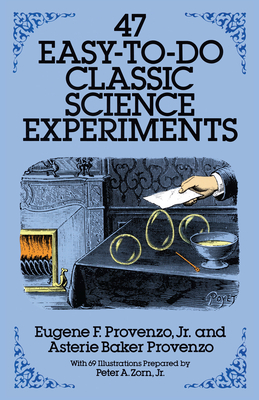
47 Easy-To-Do Classic Science Experiments
| AUTHOR | Provenzo, Eugene F.; Provenzo, Asterie Baker |
| PUBLISHER | Dover Publications (03/01/1989) |
| PRODUCT TYPE | Paperback (Paperback) |
Description
Here is a highly motivating book for grade-school students that will introduce them to many of the world's most popular (and historically significant) scientific experiments. They'll learn about gravity simply by following the acrobatic antics of an ordinary coin. By trying to blow an egg out of a cup, they'll discover the principles of air pressure. Dancing soap bubbles will help them understand the effects of static electricity, and by dropping quarters into a full glass of water without causing it to overflow, they'll study the effects of surface tension.
These and over 40 other experiments have been carefully selected by noted educators Eugene and Asterie Baker Provenzo to familiarize children with classic science experiments involving optics, inertia, air pressure, magnetism, sound, topology, light, density, vibration, prisms, elasticity, gases, vacuum, perspective, geometry, centrifugal force, buoyancy, color, and much more. Some experiments, such as the optical "Newton's Rings" are hundreds of years old. Still others, like the straw lever test, are based on Greek experiments with leverage and the center of gravity -- first carried out thousands of years ago.
Easy-to-follow instructions and illustrations show youngsters how to perform each experiment, most of which are prefaced with historical background, a list of necessary materials and an explanation of key terms. Almost all experiments can be carried out with common household items (tissue paper, scissors, tapes, rubber balloons, pens, pencils, etc.) and can be worked at home or in the classroom to demonstrate specific scientific principles or to supplement a science-curriculum unit. Sources for all historical illustrations given in the text are listed at the end of the book.
These and over 40 other experiments have been carefully selected by noted educators Eugene and Asterie Baker Provenzo to familiarize children with classic science experiments involving optics, inertia, air pressure, magnetism, sound, topology, light, density, vibration, prisms, elasticity, gases, vacuum, perspective, geometry, centrifugal force, buoyancy, color, and much more. Some experiments, such as the optical "Newton's Rings" are hundreds of years old. Still others, like the straw lever test, are based on Greek experiments with leverage and the center of gravity -- first carried out thousands of years ago.
Easy-to-follow instructions and illustrations show youngsters how to perform each experiment, most of which are prefaced with historical background, a list of necessary materials and an explanation of key terms. Almost all experiments can be carried out with common household items (tissue paper, scissors, tapes, rubber balloons, pens, pencils, etc.) and can be worked at home or in the classroom to demonstrate specific scientific principles or to supplement a science-curriculum unit. Sources for all historical illustrations given in the text are listed at the end of the book.
Show More
Product Format
Product Details
ISBN-13:
9780486258560
ISBN-10:
0486258564
Binding:
Paperback or Softback (Trade Paperback (Us))
Content Language:
English
More Product Details
Page Count:
96
Carton Quantity:
78
Product Dimensions:
5.42 x 0.27 x 8.44 inches
Weight:
0.32 pound(s)
Feature Codes:
Price on Product,
Illustrated
Country of Origin:
US
Subject Information
BISAC Categories
Science | Environmental Science (see also Chemistry - Environmental)
Science | Experiments & Projects
Grade Level:
3rd Grade
- 9th Grade
Dewey Decimal:
507.8
Library of Congress Control Number:
88031334
Descriptions, Reviews, Etc.
publisher marketing
Here is a highly motivating book for grade-school students that will introduce them to many of the world's most popular (and historically significant) scientific experiments. They'll learn about gravity simply by following the acrobatic antics of an ordinary coin. By trying to blow an egg out of a cup, they'll discover the principles of air pressure. Dancing soap bubbles will help them understand the effects of static electricity, and by dropping quarters into a full glass of water without causing it to overflow, they'll study the effects of surface tension.
These and over 40 other experiments have been carefully selected by noted educators Eugene and Asterie Baker Provenzo to familiarize children with classic science experiments involving optics, inertia, air pressure, magnetism, sound, topology, light, density, vibration, prisms, elasticity, gases, vacuum, perspective, geometry, centrifugal force, buoyancy, color, and much more. Some experiments, such as the optical "Newton's Rings" are hundreds of years old. Still others, like the straw lever test, are based on Greek experiments with leverage and the center of gravity -- first carried out thousands of years ago.
Easy-to-follow instructions and illustrations show youngsters how to perform each experiment, most of which are prefaced with historical background, a list of necessary materials and an explanation of key terms. Almost all experiments can be carried out with common household items (tissue paper, scissors, tapes, rubber balloons, pens, pencils, etc.) and can be worked at home or in the classroom to demonstrate specific scientific principles or to supplement a science-curriculum unit. Sources for all historical illustrations given in the text are listed at the end of the book.
These and over 40 other experiments have been carefully selected by noted educators Eugene and Asterie Baker Provenzo to familiarize children with classic science experiments involving optics, inertia, air pressure, magnetism, sound, topology, light, density, vibration, prisms, elasticity, gases, vacuum, perspective, geometry, centrifugal force, buoyancy, color, and much more. Some experiments, such as the optical "Newton's Rings" are hundreds of years old. Still others, like the straw lever test, are based on Greek experiments with leverage and the center of gravity -- first carried out thousands of years ago.
Easy-to-follow instructions and illustrations show youngsters how to perform each experiment, most of which are prefaced with historical background, a list of necessary materials and an explanation of key terms. Almost all experiments can be carried out with common household items (tissue paper, scissors, tapes, rubber balloons, pens, pencils, etc.) and can be worked at home or in the classroom to demonstrate specific scientific principles or to supplement a science-curriculum unit. Sources for all historical illustrations given in the text are listed at the end of the book.
Show More
List Price $5.95
Your Price
$5.89