
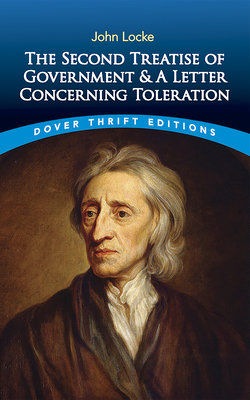
The Second Treatise of Government and a Letter Concerning Toleration
| AUTHOR | Locke, John |
| PUBLISHER | Dover Publications (08/14/2002) |
| PRODUCT TYPE | Paperback (Paperback) |
Description
A highly influential figure in the Age of Enlightenment in England and France, whose works helped inspire the Declaration of Independence and the U.S. Constitution, John Locke was one of the most important political theorists in Western history. In The Second Treatise of Government, a major contribution to the principles underlying modern democracies, he achieved two objectives: refuting the concept of the divine right of monarchy, and establishing a theory of government based on the ultimate sovereignty of the people.
In A Letter Concerning Toleration, composed as early as 1667 but not published for political reasons until 1689 -- after the "Glorious Revolution" -- Locke pleaded for religious tolerance on grounds similar to his argument for political freedom, i.e., that all men are by nature "free, equal, and independent," and are entitled to freedom of thought, freedom of speech, and freedom of worship. To help guarantee the latter freedom, Locke called for separation of church and state.
The basis of social and political philosophy for generations, these works laid the foundation of the modern democratic state in England and abroad. Their enduring importance makes them essential reading for students of philosophy, history, and political science.
In A Letter Concerning Toleration, composed as early as 1667 but not published for political reasons until 1689 -- after the "Glorious Revolution" -- Locke pleaded for religious tolerance on grounds similar to his argument for political freedom, i.e., that all men are by nature "free, equal, and independent," and are entitled to freedom of thought, freedom of speech, and freedom of worship. To help guarantee the latter freedom, Locke called for separation of church and state.
The basis of social and political philosophy for generations, these works laid the foundation of the modern democratic state in England and abroad. Their enduring importance makes them essential reading for students of philosophy, history, and political science.
Show More
Product Format
Product Details
ISBN-13:
9780486424644
ISBN-10:
0486424642
Binding:
Paperback or Softback (Trade Paperback (Us))
Content Language:
English
More Product Details
Page Count:
160
Carton Quantity:
44
Product Dimensions:
4.90 x 0.40 x 7.90 inches
Weight:
0.25 pound(s)
Feature Codes:
Price on Product,
Table of Contents
Country of Origin:
US
Subject Information
BISAC Categories
Philosophy | Political
Philosophy | Modern - 17th Century
Philosophy | European - English, Irish, Scottish, Welsh
Grade Level:
9th Grade
and up
Accelerated Reader:
Reading Level:
0
Point Value:
0
Guided Reading Level:
Not Applicable
Dewey Decimal:
320.01
Library of Congress Control Number:
2002067317
Descriptions, Reviews, Etc.
publisher marketing
A highly influential figure in the Age of Enlightenment in England and France, whose works helped inspire the Declaration of Independence and the U.S. Constitution, John Locke was one of the most important political theorists in Western history. In The Second Treatise of Government, a major contribution to the principles underlying modern democracies, he achieved two objectives: refuting the concept of the divine right of monarchy, and establishing a theory of government based on the ultimate sovereignty of the people.
In A Letter Concerning Toleration, composed as early as 1667 but not published for political reasons until 1689 -- after the "Glorious Revolution" -- Locke pleaded for religious tolerance on grounds similar to his argument for political freedom, i.e., that all men are by nature "free, equal, and independent," and are entitled to freedom of thought, freedom of speech, and freedom of worship. To help guarantee the latter freedom, Locke called for separation of church and state.
The basis of social and political philosophy for generations, these works laid the foundation of the modern democratic state in England and abroad. Their enduring importance makes them essential reading for students of philosophy, history, and political science.
In A Letter Concerning Toleration, composed as early as 1667 but not published for political reasons until 1689 -- after the "Glorious Revolution" -- Locke pleaded for religious tolerance on grounds similar to his argument for political freedom, i.e., that all men are by nature "free, equal, and independent," and are entitled to freedom of thought, freedom of speech, and freedom of worship. To help guarantee the latter freedom, Locke called for separation of church and state.
The basis of social and political philosophy for generations, these works laid the foundation of the modern democratic state in England and abroad. Their enduring importance makes them essential reading for students of philosophy, history, and political science.
Show More
List Price $7.00
Your Price
$6.93