
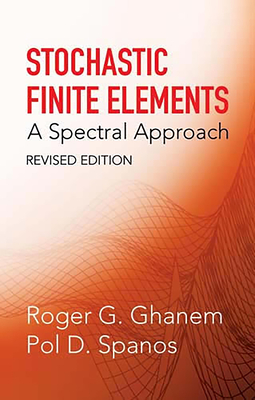
Stochastic Finite Elements: A Spectral Approach, Revised Edition
| AUTHOR | Engineering; Spanos, Pol D.; Ghanem, Roger G. |
| PUBLISHER | Dover Publications (07/17/2012) |
| PRODUCT TYPE | Paperback (Paperback) |
Description
Discrepancies frequently occur between a physical system's responses and predictions obtained from mathematical models. The Spectral Stochastic Finite Element Method (SSFEM) has proven successful at forecasting a variety of uncertainties in calculating system responses. This text analyzes a class of discrete mathematical models of engineering systems, identifying key issues and reviewing relevant theoretical concepts, with particular attention to a spectral approach.
Random system parameters are modeled as second-order stochastic processes, defined by their mean and covariance functions. Relying on the spectral properties of the covariance function, the Karhunen-Loeve expansion is employed to represent these processes in terms of a countable set of uncorrected random variables, casting the problem in a finite dimensional setting. Various spectral approximations for the stochastic response of the system are obtained. Implementing the concept of generalized inverse leads to an explicit expression for the response process as a multivariate polynomial functional of a set of uncorrelated random variables. Alternatively, the solution process is treated as an element in the Hilbert space of random functions, in which a spectral representation is identified in terms of polynomial chaos. In this context, the solution process is approximated by its projection onto a finite subspace spanned by these polynomials.
Random system parameters are modeled as second-order stochastic processes, defined by their mean and covariance functions. Relying on the spectral properties of the covariance function, the Karhunen-Loeve expansion is employed to represent these processes in terms of a countable set of uncorrected random variables, casting the problem in a finite dimensional setting. Various spectral approximations for the stochastic response of the system are obtained. Implementing the concept of generalized inverse leads to an explicit expression for the response process as a multivariate polynomial functional of a set of uncorrelated random variables. Alternatively, the solution process is treated as an element in the Hilbert space of random functions, in which a spectral representation is identified in terms of polynomial chaos. In this context, the solution process is approximated by its projection onto a finite subspace spanned by these polynomials.
Show More
Product Format
Product Details
ISBN-13:
9780486428185
ISBN-10:
0486428184
Binding:
Paperback or Softback (Trade Paperback (Us))
Content Language:
English
More Product Details
Page Count:
240
Carton Quantity:
32
Product Dimensions:
5.40 x 0.56 x 8.42 inches
Weight:
0.59 pound(s)
Feature Codes:
Bibliography,
Price on Product
Country of Origin:
US
Subject Information
BISAC Categories
Technology & Engineering | Civil - General
Technology & Engineering | Applied
Technology & Engineering | Mechanical
Dewey Decimal:
620.001
Library of Congress Control Number:
2003046062
Descriptions, Reviews, Etc.
publisher marketing
Discrepancies frequently occur between a physical system's responses and predictions obtained from mathematical models. The Spectral Stochastic Finite Element Method (SSFEM) has proven successful at forecasting a variety of uncertainties in calculating system responses. This text analyzes a class of discrete mathematical models of engineering systems, identifying key issues and reviewing relevant theoretical concepts, with particular attention to a spectral approach.
Random system parameters are modeled as second-order stochastic processes, defined by their mean and covariance functions. Relying on the spectral properties of the covariance function, the Karhunen-Loeve expansion is employed to represent these processes in terms of a countable set of uncorrected random variables, casting the problem in a finite dimensional setting. Various spectral approximations for the stochastic response of the system are obtained. Implementing the concept of generalized inverse leads to an explicit expression for the response process as a multivariate polynomial functional of a set of uncorrelated random variables. Alternatively, the solution process is treated as an element in the Hilbert space of random functions, in which a spectral representation is identified in terms of polynomial chaos. In this context, the solution process is approximated by its projection onto a finite subspace spanned by these polynomials.
Random system parameters are modeled as second-order stochastic processes, defined by their mean and covariance functions. Relying on the spectral properties of the covariance function, the Karhunen-Loeve expansion is employed to represent these processes in terms of a countable set of uncorrected random variables, casting the problem in a finite dimensional setting. Various spectral approximations for the stochastic response of the system are obtained. Implementing the concept of generalized inverse leads to an explicit expression for the response process as a multivariate polynomial functional of a set of uncorrelated random variables. Alternatively, the solution process is treated as an element in the Hilbert space of random functions, in which a spectral representation is identified in terms of polynomial chaos. In this context, the solution process is approximated by its projection onto a finite subspace spanned by these polynomials.
Show More
List Price $16.95
Your Price
$16.78