
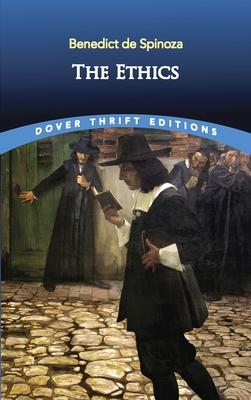
The Ethics
| AUTHOR | Elwes, R. H. M.; Spinoza, Benedict De; Spinoza, Benedictus de |
| PUBLISHER | Dover Publications (11/14/2018) |
| PRODUCT TYPE | Paperback (Paperback) |
Description
What does it mean to live an ethical life? For seventeenth-century philosopher Benedict de Spinoza, this question led to a doctrine in which God is present in all things and the human mind is part of God's infinite intellect. Spinoza regarded ethics as a rational system corresponding to the rational nature of the universe and employed a deductive method derived from Euclidean geometry to show that the validity of ethical ideas can be demonstrated by a mathematical style argument. His conclusion: to be guided by reason is to live freely, motivated by love and goodwill rather than fear or hatred.
These ideas challenged both conventional views of God and the related social and political structure. Reviled by the religious authorities of his native Amsterdam, Spinoza remained an uncompromising model of intellectual courage. His vision, published posthumously as The Ethics, has served as an inspiration to Enlightenment philosophers, Romantic poets, and generations of thinkers.
These ideas challenged both conventional views of God and the related social and political structure. Reviled by the religious authorities of his native Amsterdam, Spinoza remained an uncompromising model of intellectual courage. His vision, published posthumously as The Ethics, has served as an inspiration to Enlightenment philosophers, Romantic poets, and generations of thinkers.
Show More
Product Format
Product Details
ISBN-13:
9780486827650
ISBN-10:
0486827658
Binding:
Paperback or Softback (Trade Paperback (Us))
Content Language:
English
More Product Details
Page Count:
208
Carton Quantity:
34
Product Dimensions:
5.00 x 0.50 x 8.00 inches
Weight:
0.30 pound(s)
Feature Codes:
Price on Product
Country of Origin:
US
Subject Information
BISAC Categories
Philosophy | Ethics & Moral Philosophy
Philosophy | General
Philosophy | Individual Philosophers
Dewey Decimal:
170
Library of Congress Control Number:
2018016132
Descriptions, Reviews, Etc.
publisher marketing
What does it mean to live an ethical life? For seventeenth-century philosopher Benedict de Spinoza, this question led to a doctrine in which God is present in all things and the human mind is part of God's infinite intellect. Spinoza regarded ethics as a rational system corresponding to the rational nature of the universe and employed a deductive method derived from Euclidean geometry to show that the validity of ethical ideas can be demonstrated by a mathematical style argument. His conclusion: to be guided by reason is to live freely, motivated by love and goodwill rather than fear or hatred.
These ideas challenged both conventional views of God and the related social and political structure. Reviled by the religious authorities of his native Amsterdam, Spinoza remained an uncompromising model of intellectual courage. His vision, published posthumously as The Ethics, has served as an inspiration to Enlightenment philosophers, Romantic poets, and generations of thinkers.
These ideas challenged both conventional views of God and the related social and political structure. Reviled by the religious authorities of his native Amsterdam, Spinoza remained an uncompromising model of intellectual courage. His vision, published posthumously as The Ethics, has served as an inspiration to Enlightenment philosophers, Romantic poets, and generations of thinkers.
Show More
List Price $9.00
Your Price
$8.91