
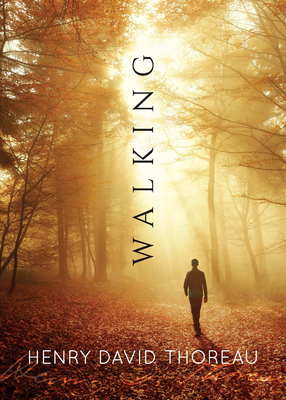
Walking
| AUTHOR | Thoreau, Henry David |
| PUBLISHER | Dover Publications (09/18/2019) |
| PRODUCT TYPE | Paperback (Paperback) |
Description
"For I believe that climate does thus react on man -- as there is something in the mountain air that feeds the spirit and inspires."
Henry David Thoreau's Walking began as a lecture in 1851 and ultimately appeared in The Atlantic Monthly in 1862, shortly after the author's death. The impassioned essay, which praises the merits of time spent in nature, has become one of the most influential works of the modern environmentalist movement. Thoreau's view of walking in nature as a self-reflective activity invites readers to embark on their own ramble in order to gain a "wild and dusky" self-knowledge unattainable elsewhere.
Americans felt the pressures of a changing world even in the relatively slow-paced 1800s, and Thoreau proposed balancing social stress with unhurried wanderings in fields and woods. His writings, from Civil Disobedience to Walden, remain popular because of their enduring relevance, and Walking bears a special resonance for modern readers who may have become disconnected from the natural world.
Henry David Thoreau's Walking began as a lecture in 1851 and ultimately appeared in The Atlantic Monthly in 1862, shortly after the author's death. The impassioned essay, which praises the merits of time spent in nature, has become one of the most influential works of the modern environmentalist movement. Thoreau's view of walking in nature as a self-reflective activity invites readers to embark on their own ramble in order to gain a "wild and dusky" self-knowledge unattainable elsewhere.
Americans felt the pressures of a changing world even in the relatively slow-paced 1800s, and Thoreau proposed balancing social stress with unhurried wanderings in fields and woods. His writings, from Civil Disobedience to Walden, remain popular because of their enduring relevance, and Walking bears a special resonance for modern readers who may have become disconnected from the natural world.
Show More
Product Format
Product Details
ISBN-13:
9780486836485
ISBN-10:
0486836487
Binding:
Paperback or Softback (Trade Paperback (Us))
Content Language:
English
More Product Details
Page Count:
80
Carton Quantity:
108
Product Dimensions:
4.90 x 0.30 x 6.80 inches
Weight:
0.20 pound(s)
Feature Codes:
Price on Product
Country of Origin:
US
Subject Information
BISAC Categories
Humor | General
Humor | Essays
Humor | Essays
Accelerated Reader:
Reading Level:
0
Point Value:
0
Guided Reading Level:
Not Applicable
Dewey Decimal:
814.3
Library of Congress Control Number:
2019016658
Descriptions, Reviews, Etc.
publisher marketing
"For I believe that climate does thus react on man -- as there is something in the mountain air that feeds the spirit and inspires."
Henry David Thoreau's Walking began as a lecture in 1851 and ultimately appeared in The Atlantic Monthly in 1862, shortly after the author's death. The impassioned essay, which praises the merits of time spent in nature, has become one of the most influential works of the modern environmentalist movement. Thoreau's view of walking in nature as a self-reflective activity invites readers to embark on their own ramble in order to gain a "wild and dusky" self-knowledge unattainable elsewhere.
Americans felt the pressures of a changing world even in the relatively slow-paced 1800s, and Thoreau proposed balancing social stress with unhurried wanderings in fields and woods. His writings, from Civil Disobedience to Walden, remain popular because of their enduring relevance, and Walking bears a special resonance for modern readers who may have become disconnected from the natural world.
Henry David Thoreau's Walking began as a lecture in 1851 and ultimately appeared in The Atlantic Monthly in 1862, shortly after the author's death. The impassioned essay, which praises the merits of time spent in nature, has become one of the most influential works of the modern environmentalist movement. Thoreau's view of walking in nature as a self-reflective activity invites readers to embark on their own ramble in order to gain a "wild and dusky" self-knowledge unattainable elsewhere.
Americans felt the pressures of a changing world even in the relatively slow-paced 1800s, and Thoreau proposed balancing social stress with unhurried wanderings in fields and woods. His writings, from Civil Disobedience to Walden, remain popular because of their enduring relevance, and Walking bears a special resonance for modern readers who may have become disconnected from the natural world.
Show More
List Price $6.95
Your Price
$6.88