
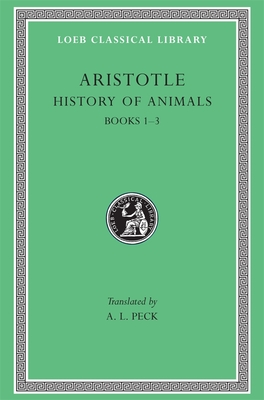
History of Animals, Volume I: Books 1-3
| AUTHOR | Peck, A. L.; Aristotle |
| PUBLISHER | Harvard University Press (01/01/1965) |
| PRODUCT TYPE | Hardcover (Hardcover) |
Description
Inductive zoology.
In History of Animals Aristotle analyzes "differences"--in parts, activities, modes of life, and character--across the animal kingdom, in preparation for establishing their causes, which are the concern of his other zoological works. Over 500 species of animals are considered: shellfish, insects, birds, fish, reptiles, amphibians, and mammals--including human beings. In Books I-IV, Aristotle gives a comparative survey of internal and external body parts, including tissues and fluids, and of sense faculties and voice. Books V-VI study reproductive methods, breeding habits, and embryogenesis as well as some secondary sex differences. In Books VII-IX, Aristotle examines differences among animals in feeding; in habitat, hibernation, migration; in enmities and sociability; in disposition (including differences related to gender) and intelligence. Here too he describes the human reproductive system, conception, pregnancy, and obstetrics. Book X establishes the female's contribution to generation. The Loeb Classical Library edition of History of Animals is in three volumes. A full index to all ten books is included in Volume Three. Related Volumes: Aristotle's biological corpus includes not only History of Animals, but also Parts of Animals, Movement of Animals, Progression of Animals, Generation of Animals, and significant parts of On the Soul and Parva Naturalia. Aristotle's general methodology--"first we must grasp the differences, then try to discover the causes" (HA 1.6)--is applied to the study of plants by his younger co-worker and heir to his school, Theophrastus: Enquiry into Plants studies differences across the plant kingdom, while De Causis Plantarum studies their causes. In the later ancient world, both Pliny's Natural History and Aelian's On the Characteristics of Animals draw significantly on Aristotle's biological work. The only work by a classical author at all comparable to Aristotle's treatises on animals is Xenophon's On Horses (included in Volume VII of the Loeb edition of Xenophon).
Show More
Product Format
Product Details
ISBN-13:
9780674994812
ISBN-10:
0674994817
Binding:
Hardback or Cased Book (Sewn)
Content Language:
Greek, Ancient (to 1453)
More Product Details
Page Count:
352
Carton Quantity:
20
Product Dimensions:
4.54 x 0.70 x 6.67 inches
Weight:
0.55 pound(s)
Feature Codes:
Dust Cover,
Price on Product
Country of Origin:
US
Subject Information
BISAC Categories
Philosophy | History & Surveys - Ancient & Classical
Philosophy | Ancient and Classical
Philosophy | Nature
Dewey Decimal:
888
Descriptions, Reviews, Etc.
publisher marketing
Inductive zoology.
In History of Animals Aristotle analyzes "differences"--in parts, activities, modes of life, and character--across the animal kingdom, in preparation for establishing their causes, which are the concern of his other zoological works. Over 500 species of animals are considered: shellfish, insects, birds, fish, reptiles, amphibians, and mammals--including human beings. In Books I-IV, Aristotle gives a comparative survey of internal and external body parts, including tissues and fluids, and of sense faculties and voice. Books V-VI study reproductive methods, breeding habits, and embryogenesis as well as some secondary sex differences. In Books VII-IX, Aristotle examines differences among animals in feeding; in habitat, hibernation, migration; in enmities and sociability; in disposition (including differences related to gender) and intelligence. Here too he describes the human reproductive system, conception, pregnancy, and obstetrics. Book X establishes the female's contribution to generation. The Loeb Classical Library edition of History of Animals is in three volumes. A full index to all ten books is included in Volume Three. Related Volumes: Aristotle's biological corpus includes not only History of Animals, but also Parts of Animals, Movement of Animals, Progression of Animals, Generation of Animals, and significant parts of On the Soul and Parva Naturalia. Aristotle's general methodology--"first we must grasp the differences, then try to discover the causes" (HA 1.6)--is applied to the study of plants by his younger co-worker and heir to his school, Theophrastus: Enquiry into Plants studies differences across the plant kingdom, while De Causis Plantarum studies their causes. In the later ancient world, both Pliny's Natural History and Aelian's On the Characteristics of Animals draw significantly on Aristotle's biological work. The only work by a classical author at all comparable to Aristotle's treatises on animals is Xenophon's On Horses (included in Volume VII of the Loeb edition of Xenophon).
Show More
Author:
Aristotle
Other works by the renowned classical scholar, translator, and literary critic Francis Fergusson include "The Idea of a Theater: A Study of Ten Plays," "Sallies of the Mind: Essays," "Trope and Allegory: Themes Common to Dante and Shakespeare," and "Dante's Drama of the Mind: A Modern Reading of the "Purgatorio.
Translator and scholar S. H. Butcher served as editor for the Dover Thift Edition of the "Poetics," as well as for the "Orationes, Volume 1" by Demosthenes. Butcher is also the author of "Aristotle's Theory of Poetry and Fine Art,"
Translator and scholar S. H. Butcher served as editor for the Dover Thift Edition of the "Poetics," as well as for the "Orationes, Volume 1" by Demosthenes. Butcher is also the author of "Aristotle's Theory of Poetry and Fine Art,"
Show More
Your Price
$29.70