
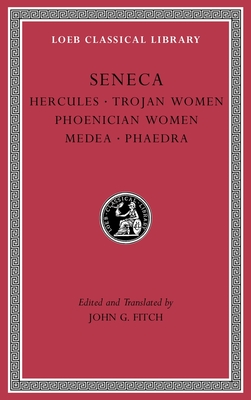
Tragedies, Volume I: Hercules. Trojan Women. Phoenician Women. Medea. Phaedra
| AUTHOR | Seneca, Lucius Annaeus; Seneca; Fitch, John G. et al. |
| PUBLISHER | Harvard University Press (06/01/2018) |
| PRODUCT TYPE | Hardcover (Hardcover) |
Description
Spectacular verse drama.
Seneca is a figure of first importance in both Roman politics and literature: a leading adviser to Nero who attempted to restrain the emperor's megalomania; a prolific moral philosopher; and the author of verse tragedies that strongly influenced Shakespeare and other Renaissance dramatists. Seneca's plays depict intense passions and interactions in rhetoric that is equally strong. Their perspective is much bleaker than that adopted in his prose writings. His plots are based on mythical episodes, in keeping with classical tradition. But the political realities of imperial Rome are also reflected in an obsessive concern with power and dominion over others. The Octavia is our sole surviving example of a Roman historical play; set at Nero's court, it was probably written by an admirer of Seneca as statesman and dramatist. John G. Fitch has thoroughly revised his two-volume edition of Seneca's Tragedies to take account of the textual and interpretive scholarship that has appeared since its initial publication. His translation conveys the force of Seneca's dramatic language and the lyric quality of his choral odes.
Show More
Product Format
Product Details
ISBN-13:
9780674997172
ISBN-10:
0674997174
Binding:
Hardback or Cased Book (Sewn)
Content Language:
Latin
More Product Details
Page Count:
576
Carton Quantity:
20
Product Dimensions:
4.30 x 1.20 x 6.50 inches
Weight:
0.88 pound(s)
Feature Codes:
Bibliography,
Price on Product
Country of Origin:
US
Subject Information
BISAC Categories
Drama | Ancient & Classical
Drama | Ancient and Classical
Drama | Ancient & Classical
Dewey Decimal:
872.01
Library of Congress Control Number:
2017956657
Descriptions, Reviews, Etc.
publisher marketing
Spectacular verse drama.
Seneca is a figure of first importance in both Roman politics and literature: a leading adviser to Nero who attempted to restrain the emperor's megalomania; a prolific moral philosopher; and the author of verse tragedies that strongly influenced Shakespeare and other Renaissance dramatists. Seneca's plays depict intense passions and interactions in rhetoric that is equally strong. Their perspective is much bleaker than that adopted in his prose writings. His plots are based on mythical episodes, in keeping with classical tradition. But the political realities of imperial Rome are also reflected in an obsessive concern with power and dominion over others. The Octavia is our sole surviving example of a Roman historical play; set at Nero's court, it was probably written by an admirer of Seneca as statesman and dramatist. John G. Fitch has thoroughly revised his two-volume edition of Seneca's Tragedies to take account of the textual and interpretive scholarship that has appeared since its initial publication. His translation conveys the force of Seneca's dramatic language and the lyric quality of his choral odes.
Show More
Your Price
$29.70