
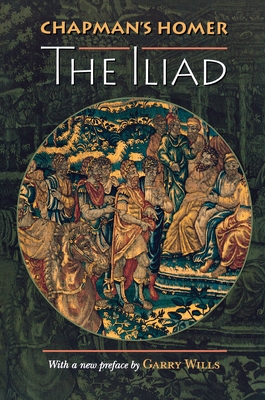
Chapman's Homer: The Iliad
| AUTHOR | Chapman, George; Homer; Nicoll, Allardyce et al. |
| PUBLISHER | Princeton University Press (12/13/1998) |
| PRODUCT TYPE | Paperback (Paperback) |
George Chapman's translations of Homer are the most famous in the English language. Keats immortalized the work of the Renaissance dramatist and poet in the sonnet "On First Looking into Chapman's Homer." Swinburne praised the translations for their "romantic and sometimes barbaric grandeur," their "freshness, strength, and inextinguishable fire." The great critic George Saintsbury (1845-1933) wrote: "For more than two centuries they were the resort of all who, unable to read Greek, wished to know what Greek was. Chapman is far nearer Homer than any modern translator in any modern language."
This volume presents the original (1611) text of Chapman's translation of the Iliad, making only a small number of modifications to punctuation and wording where they might confuse the modern reader. The editor, Allardyce Nicoll, provides an introduction and a glossary. Garry Wills contributes a preface, in which he explains how Chapman tapped into the poetic consonance between the semi-divine heroism of the Iliad's warriors and the cosmological symbols of Renaissance humanism."Oft of one wide expanse had I been told
That deep-browed Homer ruled as his demesne;
Yet did I never breathe its pure serene
Till I heard Chapman speak out loud and bold."--John Keats
"Chapman's Homer provided for the Iliad and the Odyssey exactly what the King James Bible (also published in 1611) did for the Hebrew Bible and the New Testament in English: it offered a stylistically vigorous and morally powerful translation that has influenced generations of subsequent readers, even as new versions have proliferated."--Jan M. Ziolkowski, Harvard University
"Chapman's versions inspired English poets for centuries after his time. They rest on a minute and perceptive reading of the texts. And they retain their power to fascinate and provoke anyone interested in Homer and his afterlife, in Renaissance ideas about classical and modern poetry, or in the development of the language of English poetry."--Anthony T. Grafton, Princeton University
George Chapman's translations of Homer are the most famous in the English language. Keats immortalized the work of the Renaissance dramatist and poet in the sonnet "On First Looking into Chapman's Homer." Swinburne praised the translations for their "romantic and sometimes barbaric grandeur," their "freshness, strength, and inextinguishable fire." The great critic George Saintsbury (1845-1933) wrote: "For more than two centuries they were the resort of all who, unable to read Greek, wished to know what Greek was. Chapman is far nearer Homer than any modern translator in any modern language."
This volume presents the original (1611) text of Chapman's translation of the Iliad, making only a small number of modifications to punctuation and wording where they might confuse the modern reader. The editor, Allardyce Nicoll, provides an introduction and a glossary. Garry Wills contributes a preface, in which he explains how Chapman tapped into the poetic consonance between the semi-divine heroism of the Iliad's warriors and the cosmological symbols of Renaissance humanism.