
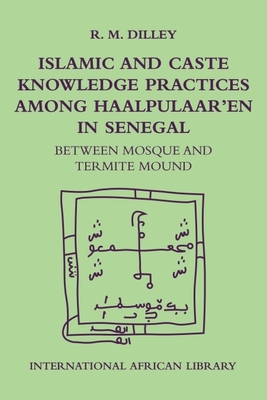
Islamic and Caste Knowledge Practices Among Haalpulaaren in Senegal: Between Mosque and Termite Mound
| AUTHOR | Dilley, Roy |
| PUBLISHER | Edinburgh University Press (06/21/2004) |
| PRODUCT TYPE | Paperback (Paperback) |
Description
This book examines in historical perspective the hitherto little-studied relationship between Islam and caste among the Haalpulaaren of Senegal. The Islamic uprising of the 1770s, which established a class of Islamic clerics in positions of authority in the Senegal river valley, had long-term consequences for the social relations between clerics and caste groups. The book examines how at different historical junctures attempts were made to negotiate the equalitarian claims of a universalist faith with the expression of social differentiation lying at the heart of caste inequality. While the existing literature focuses on those who established Islam within the region, this present work provides insights into how marginalised artisans, poets and musicians understood themselves and how they responded to a faith which had become the cornerstone of social prestige and status. It analyses the knowledge practices of clerics and of specialised craft groups, arguing that they are crucial for our understanding of social and cultural distinction. This involves a synthesis of historical sources and ethnography, and provides an innovative approach to the study of religious identity and specialist practitioners.
Show More
Product Format
Product Details
ISBN-13:
9780748619900
ISBN-10:
0748619909
Binding:
Paperback or Softback (Trade Paperback (Us))
Content Language:
English
More Product Details
Page Count:
270
Carton Quantity:
20
Product Dimensions:
6.62 x 0.57 x 9.28 inches
Weight:
1.08 pound(s)
Feature Codes:
Price on Product
Country of Origin:
US
Subject Information
BISAC Categories
History | Africa - General
History | Islam - Rituals & Practice
Grade Level:
Post Graduate
and up
Dewey Decimal:
297.089
Descriptions, Reviews, Etc.
publisher marketing
This book examines in historical perspective the hitherto little-studied relationship between Islam and caste among the Haalpulaaren of Senegal. The Islamic uprising of the 1770s, which established a class of Islamic clerics in positions of authority in the Senegal river valley, had long-term consequences for the social relations between clerics and caste groups. The book examines how at different historical junctures attempts were made to negotiate the equalitarian claims of a universalist faith with the expression of social differentiation lying at the heart of caste inequality. While the existing literature focuses on those who established Islam within the region, this present work provides insights into how marginalised artisans, poets and musicians understood themselves and how they responded to a faith which had become the cornerstone of social prestige and status. It analyses the knowledge practices of clerics and of specialised craft groups, arguing that they are crucial for our understanding of social and cultural distinction. This involves a synthesis of historical sources and ethnography, and provides an innovative approach to the study of religious identity and specialist practitioners.
Show More
Author:
Dilley, Roy
Roy Dilley is senior lecturer in social anthropology, University of St. Andrews, Scotland.
Show More
List Price $44.95
Your Price
$44.50