
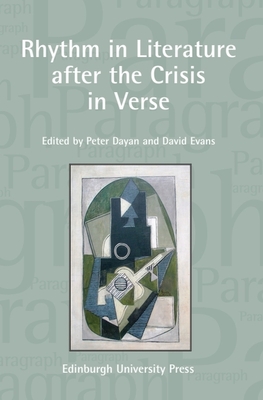
Rhythm in Literature After the Crisis in Verse: Paragraph Volume 33, Number 2
| PUBLISHER | Edinburgh University Press (07/15/2010) |
| PRODUCT TYPE | Paperback (Paperback) |
Description
Shout lineTraces rhythm in literature in the analysable patterns of metrical verse as it unfolds in the work of post-crisis writersBefore the 'crise de vers' which Mallarm diagnosed in the 1880s, just as rhythm in music had to do with note values and repeated patterns, so rhythm in literature could be safely sought in the analysable patterns of metrical verse. The crisis abolished that security yet the conviction that rhythm is fundamental to literature survived that destruction. Tracing rhythm as it unfolds in the work of post-crisis writers from Valry, Woolf, Campana, and the Dadaists, via the strange history of Russian verse under Communism, to Rda, Cortzar, and John Wilkinson, this volume seeks to found such a theory precisely in the space between rhythm's elusiveness as a general concept, and the continuing specific force of its presence in the works of literature.Before the 'crise de vers' which Mallarm diagnosed in the 1880s, just as rhythm in music had to do with note values and repeated patterns, so rhythm in literature could be safely sought in the analysable patterns of metrical verse. The crisis abolished that security: free verse and prose poetry destroyed the privilege of the old countable rhythms. Yet the conviction that rhythm is fundamental to literature survived that destruction. How? Why? Is there really anything one can say, any theory that can measure up to rhythm since the crisis, to a rhythm that cannot be localised in measurable convention? Tracing rhythm as it unfolds in the work of post-crisis writers from Valry, Woolf, Campana, and the Dadaists, via the strange history of Russian verse under Communism, to Rda, Cortzar, and John Wilkinson, this volume seeks to found such a theory precisely in the space between rhythm's elusiveness as a general concept, and the continuing specific force of its presence in the works of literature.
Show More
Product Format
Product Details
ISBN-13:
9780748640645
ISBN-10:
0748640649
Binding:
Paperback or Softback (Trade Paperback (Us))
Content Language:
English
More Product Details
Page Count:
128
Carton Quantity:
20
Feature Codes:
Price on Product
Country of Origin:
US
Subject Information
BISAC Categories
Literary Criticism | Semiotics & Theory
Literary Criticism | Poetry
Grade Level:
Post Graduate
and up
Dewey Decimal:
809.9
Descriptions, Reviews, Etc.
publisher marketing
Shout lineTraces rhythm in literature in the analysable patterns of metrical verse as it unfolds in the work of post-crisis writersBefore the 'crise de vers' which Mallarm diagnosed in the 1880s, just as rhythm in music had to do with note values and repeated patterns, so rhythm in literature could be safely sought in the analysable patterns of metrical verse. The crisis abolished that security yet the conviction that rhythm is fundamental to literature survived that destruction. Tracing rhythm as it unfolds in the work of post-crisis writers from Valry, Woolf, Campana, and the Dadaists, via the strange history of Russian verse under Communism, to Rda, Cortzar, and John Wilkinson, this volume seeks to found such a theory precisely in the space between rhythm's elusiveness as a general concept, and the continuing specific force of its presence in the works of literature.Before the 'crise de vers' which Mallarm diagnosed in the 1880s, just as rhythm in music had to do with note values and repeated patterns, so rhythm in literature could be safely sought in the analysable patterns of metrical verse. The crisis abolished that security: free verse and prose poetry destroyed the privilege of the old countable rhythms. Yet the conviction that rhythm is fundamental to literature survived that destruction. How? Why? Is there really anything one can say, any theory that can measure up to rhythm since the crisis, to a rhythm that cannot be localised in measurable convention? Tracing rhythm as it unfolds in the work of post-crisis writers from Valry, Woolf, Campana, and the Dadaists, via the strange history of Russian verse under Communism, to Rda, Cortzar, and John Wilkinson, this volume seeks to found such a theory precisely in the space between rhythm's elusiveness as a general concept, and the continuing specific force of its presence in the works of literature.
Show More
Editor:
Evans, David
David Evans is the author of the catalogue raisonne "John Heartfield: AIZ/VI 1930-38" and a Research Fellow in Photography at the Arts Institute, Bournemouth, England. He has published numerous articles in such journals as "Afterimage, Eye, " and "Source."
Show More
Editor:
Dayan, Peter
Peter Dayan is Professor and Director of the Gatsby Computational Neuroscience Unit at University College London.
Show More
List Price $29.95
Your Price
$29.65