
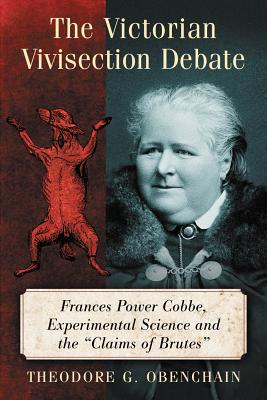
The Victorian Vivisection Debate: Frances Power Cobbe, Experimental Science and the "Claims of Brutes"
| AUTHOR | Obenchain, Theodore G. |
| PUBLISHER | McFarland & Company (11/16/2012) |
| PRODUCT TYPE | Paperback (Paperback) |
Is it justifiable for scientists to subject live animals to open operations--forcing them to suffer for the benefit of humans? This book expounds upon a debate among such experimental scientists as Joseph Lister, Louis Pasteur and Robert Koch in Victorian England--at a time in which animal cruelty (bear-baiting, e.g.) was ubiquitous. Journalist and reformer Frances Power Cobbe became so incensed that she devoted her political and legislative talents over a thirty year period to prohibiting vivisection.
Struggling within severe medical limitations was London surgeon Lister, hardly able to operate for fear his patients would succumb to sepsis. After reading of Pasteur's new theory about germs, Lister helped revolutionize hospital care.
These two scientists and Koch then expanded the scientific base by animal experiments. As their methods improved, they transformed medicine into a beneficent institution within British culture. No single adversarial movement could have held back the tide of modernism. The author brings the debate up to the 21st century by analyzing modern-day animal rights theories, and offers a credo for readers who remain undecided.
Struggling within the medical medievalism of the times was London surgeon Lister, hardly able to operate for fear his patients would succumb to sepsis. After reading of Pasteur's new theory about germs, Lister devised a system of antisepsis that slowly revolutionized hospital care.
These two scientists and Koch further expanded the scientific base by experimenting further on animals As their methods improved, they transformed medicine into a beneficent force so obvious that it inevitably became institutionalized into British culture. No single adversarial movement, regardless of its level of idealism, could have held back the tide of modernism. In the latter chapters the author brings the debate up to the 21st century by analyzing modern-day animal rights theories, and offers a credo for those readers who remain undecided.
Is it justifiable for scientists to subject live animals to open operations--forcing them to suffer for the benefit of humans? This book expounds upon a debate among such experimental scientists as Joseph Lister, Louis Pasteur and Robert Koch in Victorian England--at a time in which animal cruelty (bear-baiting, e.g.) was ubiquitous. Journalist and reformer Frances Power Cobbe became so incensed that she devoted her political and legislative talents over a thirty year period to prohibiting vivisection.
Struggling within severe medical limitations was London surgeon Lister, hardly able to operate for fear his patients would succumb to sepsis. After reading of Pasteur's new theory about germs, Lister helped revolutionize hospital care.
These two scientists and Koch then expanded the scientific base by animal experiments. As their methods improved, they transformed medicine into a beneficent institution within British culture. No single adversarial movement could have held back the tide of modernism. The author brings the debate up to the 21st century by analyzing modern-day animal rights theories, and offers a credo for readers who remain undecided.