
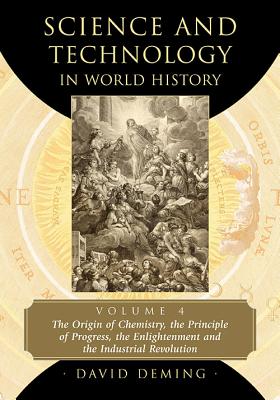
Science and Technology in World History, Volume 4: The Origin of Chemistry, the Principle of Progress, the Enlightenment and the Industrial Revolution
| AUTHOR | Deming, David |
| PUBLISHER | McFarland & Company (04/13/2016) |
| PRODUCT TYPE | Paperback (Paperback) |
The history of science is a story of human discovery--intertwined with religion, philosophy, economics and technology. The fourth in a series, this book covers the beginnings of the modern world, when 16th-century Europeans began to realize that their scientific achievements surpassed those of the Greeks and Romans. Western Civilization organized itself around the idea that human technological and moral progress was achievable and desirable. Science emerged in 17th-century Europe as scholars subordinated reason to empiricism.
Inspired by the example of physics, men like Robert Boyle began the process of changing alchemy into the exact science of chemistry. During the 18th century, European society became more secular and tolerant. Philosophers and economists developed many of the ideas underpinning modern social theories and economic policies. As the Industrial Revolution fundamentally transformed the world by increasing productivity, people became more affluent, better educated and urbanized, and the world entered an era of unprecedented prosperity and progress.
The history of science is a story of human discovery--intertwined with religion, philosophy, economics and technology. The fourth in a series, this book covers the beginnings of the modern world, when 16th-century Europeans began to realize that their scientific achievements surpassed those of the Greeks and Romans. Western Civilization organized itself around the idea that human technological and moral progress was achievable and desirable. Science emerged in 17th-century Europe as scholars subordinated reason to empiricism.
Inspired by the example of physics, men like Robert Boyle began the process of changing alchemy into the exact science of chemistry. During the 18th century, European society became more secular and tolerant. Philosophers and economists developed many of the ideas underpinning modern social theories and economic policies. As the Industrial Revolution fundamentally transformed the world by increasing productivity, people became more affluent, better educated and urbanized, and the world entered an era of unprecedented prosperity and progress.