
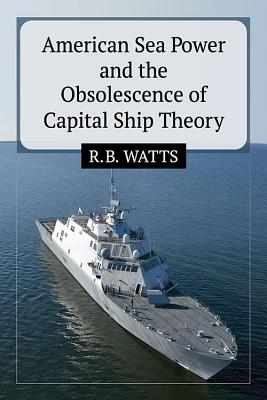
American Sea Power and the Obsolescence of Capital Ship Theory
| AUTHOR | Watts, R. B. |
| PUBLISHER | McFarland & Company (11/13/2015) |
| PRODUCT TYPE | Paperback (Paperback) |
Since the beginning of the 20th century, the United States has sought to achieve Admiral Alfred Thayer Mahan's vision of "command of the sea" using large battle fleets of capital ships. This strategy has been generally successful: no force can oppose the U.S. Navy on the open seas.
Yet capital ship theory has become increasingly irrelevant. Globally, irregular warfare dominates the spectrum of conflict, especially in the aftermath of 9/11. Fleet engagements are a thing of the past and even small scale missions that rely on capital ships are challenged by irregular warfare.
In a pattern evident since World War II, the U.S. Navy has attempted to adapt its capital ship theory to irregular conflicts--with mixed results--before returning to traditional operations with little or no strategic debate. This book discusses the challenges of irregular warfare in the 21st century, and the need for U.S. naval power to develop a new strategic paradigm.
Since the beginning of the 20th century, the United States has sought to achieve Admiral Alfred Thayer Mahan's vision of "command of the sea" using large battle fleets of capital ships. This strategy has been generally successful: no force can oppose the U.S. Navy on the open seas.
Yet capital ship theory has become increasingly irrelevant. Globally, irregular warfare dominates the spectrum of conflict, especially in the aftermath of 9/11. Fleet engagements are a thing of the past and even small scale missions that rely on capital ships are challenged by irregular warfare.
In a pattern evident since World War II, the U.S. Navy has attempted to adapt its capital ship theory to irregular conflicts--with mixed results--before returning to traditional operations with little or no strategic debate. This book discusses the challenges of irregular warfare in the 21st century, and the need for U.S. naval power to develop a new strategic paradigm.