
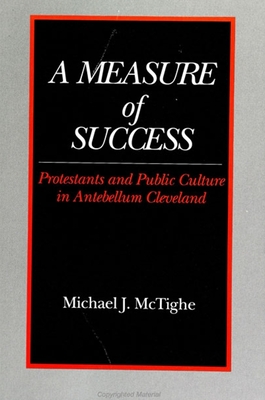
A Measure of Success: Protestants and Public Culture in Antebellum Cleveland
| AUTHOR | McTighe, Michael J. |
| PUBLISHER | State University of New York Press (03/10/1994) |
| PRODUCT TYPE | Paperback (Paperback) |
This book examines the role Protestants played in the formation of the public culture of antebellum Cleveland, a developing commercial city typical of many cities throughout the Midwest. The author analyzes the extent to which, and the way in which, Protestants were able to exercise power in the city, concluding that they achieved a measure of success during the years 1836 to 1860, after which their power began to erode. As a framework for this analysis, he develops a methodology for measuring the success, or influence, of religion in a particular society.
By focusing on the public culture, this book encompasses both the formal and informal uses of power and the public, quasi-public, and private activities of Protestants. This allows for a discussion of a broader spectrum of culture-shaping activity than is usually included in studies of religion and society, including an examination of contests within the Protestant community over identity and commitments and attitudes toward economic development, benevolent work, temperance agitation, antislavery campaigns, participation in civic rituals, and the social bases of Protestant influence.
This book examines the role Protestants played in the formation of the public culture of antebellum Cleveland, a developing commercial city typical of many cities throughout the Midwest. The author analyzes the extent to which, and the way in which, Protestants were able to exercise power in the city, concluding that they achieved a measure of success during the years 1836 to 1860, after which their power began to erode. As a framework for this analysis, he develops a methodology for measuring the success, or influence, of religion in a particular society.
By focusing on the public culture, this book encompasses both the formal and informal uses of power and the public, quasi-public, and private activities of Protestants. This allows for a discussion of a broader spectrum of culture-shaping activity than is usually included in studies of religion and society, including an examination of contests within the Protestant community over identity and commitments and attitudes toward economic development, benevolent work, temperance agitation, antislavery campaigns, participation in civic rituals, and the social bases of Protestant influence.