
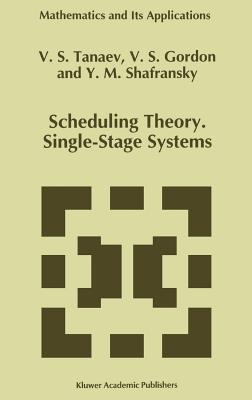
Scheduling Theory. Single-Stage Systems
| AUTHOR | Shafransky, Yakov M.; Tanaev, V.; Gordon, W. |
| PUBLISHER | Springer (05/31/1994) |
| PRODUCT TYPE | Hardcover (Hardcover) |
Description
Scheduling theory is an important branch of operations research. Problems studied within the framework of that theory have numerous applications in various fields of human activity. As an independent discipline scheduling theory appeared in the middle of the fifties, and has attracted the attention of researchers in many countries. In the Soviet Union, research in this direction has been mainly related to production scheduling, especially to the development of automated systems for production control. In 1975 Nauka ("Science") Publishers, Moscow, issued two books providing systematic descriptions of scheduling theory. The first one was the Russian translation of the classical book Theory of Scheduling by American mathematicians R. W. Conway, W. L. Maxwell and L. W. Miller. The other one was the book Introduction to Scheduling Theory by Soviet mathematicians V. S. Tanaev and V. V. Shkurba. These books well complement each other. Both. books well represent major results known by that time, contain an exhaustive bibliography on the subject. Thus, the books, as well as the Russian translation of Computer and Job-Shop Scheduling Theory edited by E. G. Coffman, Jr., (Nauka, 1984) have contributed to the development of scheduling theory in the Soviet Union. Many different models, the large number of new results make it difficult for the researchers who work in related fields to follow the fast development of scheduling theory and to master new methods and approaches quickly.
Show More
Product Format
Product Details
ISBN-13:
9780792328537
ISBN-10:
0792328531
Binding:
Hardback or Cased Book (Sewn)
Content Language:
English
More Product Details
Page Count:
374
Carton Quantity:
22
Product Dimensions:
6.48 x 1.06 x 9.54 inches
Weight:
1.63 pound(s)
Feature Codes:
Bibliography,
Index,
Illustrated
Country of Origin:
US
Subject Information
BISAC Categories
Business & Economics | Management - General
Business & Economics | Linear & Nonlinear Programming
Business & Economics | Computer Science
Dewey Decimal:
658.533
Library of Congress Control Number:
94014887
Descriptions, Reviews, Etc.
publisher marketing
Scheduling theory is an important branch of operations research. Problems studied within the framework of that theory have numerous applications in various fields of human activity. As an independent discipline scheduling theory appeared in the middle of the fifties, and has attracted the attention of researchers in many countries. In the Soviet Union, research in this direction has been mainly related to production scheduling, especially to the development of automated systems for production control. In 1975 Nauka ("Science") Publishers, Moscow, issued two books providing systematic descriptions of scheduling theory. The first one was the Russian translation of the classical book Theory of Scheduling by American mathematicians R. W. Conway, W. L. Maxwell and L. W. Miller. The other one was the book Introduction to Scheduling Theory by Soviet mathematicians V. S. Tanaev and V. V. Shkurba. These books well complement each other. Both. books well represent major results known by that time, contain an exhaustive bibliography on the subject. Thus, the books, as well as the Russian translation of Computer and Job-Shop Scheduling Theory edited by E. G. Coffman, Jr., (Nauka, 1984) have contributed to the development of scheduling theory in the Soviet Union. Many different models, the large number of new results make it difficult for the researchers who work in related fields to follow the fast development of scheduling theory and to master new methods and approaches quickly.
Show More
List Price $54.99
Your Price
$54.44