
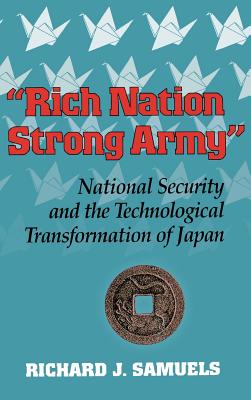
Rich Nation, Strong Army
| AUTHOR | Samuels, Richard J. |
| PUBLISHER | Cornell University Press (03/28/1994) |
| PRODUCT TYPE | Hardcover (Hardcover) |
Since World War II, Japan has become not only a model producer of high-tech consumer goods, but also-despite minimal spending on defense-a leader in innovative technology with both military and civilian uses. In the United States, nearly one in every three scientists and engineers was engaged in defense-related research and development at the end of the Cold War, but the relative strength of the American economy has declined in recent years. What is the relationship between what has happened in the two countries? And where did Japan's technological excellence come from? In an economic history that will arouse controversy on both sides of the Pacific, Richard J. Samuels finds a key to Japan's success in an ideology of technological development that advances national interests. From 1868 until 1945, the Japanese economy was fired by the development of technology to enhance national security; the rallying cry "Rich Nation, Strong Army" accompanied the expanded military spending and aggressive foreign policy that led to the disasters of the War in the Pacific. Postwar economic planners reversed the assumptions that had driven Japan's industrialization, Samuels shows, promoting instead the development of commercial technology and infrastructure. By valuing process improvements as much as product innovation, the modern Japanese system has built up the national capacity to innovate while ensuring that technological advances have been diffused broadly through industries such as aerospace that have both civilian and military applications. Struggling with the uncertainties of a post-Cold War economy, the United States has important lessons to learn from the way Japan has subordinated defense production yet emerged as one of the most technologically sophisticated nations in the world. The Japanese, like the Venetians and the Dutch before them, show us that butter is just as likely as guns to make a nation strong, but that nations cannot hope to be strong without an ideology of technological development that nourishes the entire national economy.
Since World War II, Japan has become not only a model producer of high-tech consumer goods, but also-despite minimal spending on defense-a leader in innovative technology with both military and civilian uses. In the United States, nearly one in every three scientists and engineers was engaged in defense-related research and development at the end of the Cold War, but the relative strength of the American economy has declined in recent years. What is the relationship between what has happened in the two countries? And where did Japan's technological excellence come from? In an economic history that will arouse controversy on both sides of the Pacific, Richard J. Samuels finds a key to Japan's success in an ideology of technological development that advances national interests. From 1868 until 1945, the Japanese economy was fired by the development of technology to enhance national security; the rallying cry "Rich Nation, Strong Army" accompanied the expanded military spending and aggressive foreign policy that led to the disasters of the War in the Pacific. Postwar economic planners reversed the assumptions that had driven Japan's industrialization, Samuels shows, promoting instead the development of commercial technology and infrastructure. By valuing process improvements as much as product innovation, the modern Japanese system has built up the national capacity to innovate while ensuring that technological advances have been diffused broadly through industries such as aerospace that have both civilian and military applications. Struggling with the uncertainties of a post-Cold War economy, the United States has important lessons to learn from the way Japan has subordinated defense production yet emerged as one of the most technologically sophisticated nations in the world. The Japanese, like the Venetians and the Dutch before them, show us that butter is just as likely as guns to make a nation strong, but that nations cannot hope to be strong without an ideology of technological development that nourishes the entire national economy.