
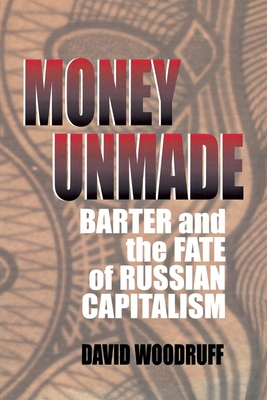
Money Unmade: Barter and the Fate of Russian Capitalism
| AUTHOR | Woodruff, David M.; Woodruff, David |
| PUBLISHER | Cornell University Press (05/13/1999) |
| PRODUCT TYPE | Hardcover (Hardcover) |
Since the collapse of the Soviet Union, Russians have seen the ruble steadily lose ground to alternative means of payment such as barter and privately issued quasi-monies. Industry now collects as much as 70 percent of its receipts in nonmonetary form, leaving many firms with too little cash to pay salaries and taxes. In this ground-breaking book on the Russian economy, David Woodruff argues that Moscow's inability to control the nation's currency is not a carry-over from the Soviet past. Rather, the Russian government has failed to build the administrative capacity and political support demanded by monetary consolidation--a neglected but crucial aspect of capitalist statebuilding. Drawing on a vast array of empirical evidence, Woodruff shows how the widespread use of barter arose as local authorities tried to protect industry against the destructive effects of price increases and crude tax and accounting systems. As businesses fled or were driven from the money economy, provincial governments invented new ways to tax in kind and issued substitutes for the ruble. In turn, the federal authorities, unable to coerce firms either to operate in the money economy or to abandon business altogether, were forced to make accommodations to barter and to ruble alternatives. Woodruff describes the enormous fiscal difficulties that resulted and recounts the intense political battles over attempts to address the problem. Through an overview of monetary consolidation in other nations, Woodruff demonstrates that the struggles of the new Russian state have much to teach us about the political history of money worldwide. Sovereignty over money cannot, he argues, be imposed by government on a recalcitrant society. Nor can it be assumed as a by-product of disciplined policies aimed at market reform. Monetary consolidation is, at heart, a political achievement requiring political support.
Since the collapse of the Soviet Union, Russians have seen the ruble steadily lose ground to alternative means of payment such as barter and privately issued quasi-monies. Industry now collects as much as 70 percent of its receipts in nonmonetary form, leaving many firms with too little cash to pay salaries and taxes. In this ground-breaking book on the Russian economy, David Woodruff argues that Moscow's inability to control the nation's currency is not a carry-over from the Soviet past. Rather, the Russian government has failed to build the administrative capacity and political support demanded by monetary consolidation--a neglected but crucial aspect of capitalist statebuilding. Drawing on a vast array of empirical evidence, Woodruff shows how the widespread use of barter arose as local authorities tried to protect industry against the destructive effects of price increases and crude tax and accounting systems. As businesses fled or were driven from the money economy, provincial governments invented new ways to tax in kind and issued substitutes for the ruble. In turn, the federal authorities, unable to coerce firms either to operate in the money economy or to abandon business altogether, were forced to make accommodations to barter and to ruble alternatives. Woodruff describes the enormous fiscal difficulties that resulted and recounts the intense political battles over attempts to address the problem. Through an overview of monetary consolidation in other nations, Woodruff demonstrates that the struggles of the new Russian state have much to teach us about the political history of money worldwide. Sovereignty over money cannot, he argues, be imposed by government on a recalcitrant society. Nor can it be assumed as a by-product of disciplined policies aimed at market reform. Monetary consolidation is, at heart, a political achievement requiring political support.