
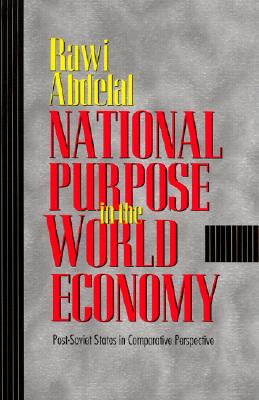
National Purpose in the World Economy
| AUTHOR | Abdelal, Rawi |
| PUBLISHER | Cornell University Press (11/06/2001) |
| PRODUCT TYPE | Hardcover (Hardcover) |
How do national identities affect the world economy? Building on the insight that nationalisms and national identities endow economic policy with social purpose, Rawi Abdelal proposes a novel theoretical framework, a distinctively Nationalist perspective on international political economy, to answer this question. Using this framework, and drawing on field research in Lithuania, Ukraine, and Belarus, he provides an in-depth look at the link between national identity and the economic policies of the new states formed by the breakup of the Soviet Union.All these states, from the Baltic coast to central Asia, were economically dependent on Russia during the 1990s. However, they reacted very differently to that dependence, and their reactions can be traced, Abdelal contends, to their individual societies. Some, such as Belarus, found dependence inevitable and sought economic reintegration with Russia. Others, like Lithuania, interpreted dependence as a large-scale security threat and reoriented their economies away from Russia. A third group, typified by Ukraine, demonstrated no coherent economic policy at all regarding dependence.Abdelal distinguishes the Nationalist tradition in international political economy from the Realist tradition, and shows that economic nationalism is different than mercantilism. He demonstrates the ways that national identity affects economic policy and explains why some governments seek economic autonomy while others prefer regional reintegration. He then applies his approach to other cases of economic reorganization after the end of empire--eastern Europe in the 1920s after the Habsburgs, 1950s Indonesia, and French West Africa in the 1960s.
How do national identities affect the world economy? Building on the insight that nationalisms and national identities endow economic policy with social purpose, Rawi Abdelal proposes a novel theoretical framework, a distinctively Nationalist perspective on international political economy, to answer this question. Using this framework, and drawing on field research in Lithuania, Ukraine, and Belarus, he provides an in-depth look at the link between national identity and the economic policies of the new states formed by the breakup of the Soviet Union.All these states, from the Baltic coast to central Asia, were economically dependent on Russia during the 1990s. However, they reacted very differently to that dependence, and their reactions can be traced, Abdelal contends, to their individual societies. Some, such as Belarus, found dependence inevitable and sought economic reintegration with Russia. Others, like Lithuania, interpreted dependence as a large-scale security threat and reoriented their economies away from Russia. A third group, typified by Ukraine, demonstrated no coherent economic policy at all regarding dependence.Abdelal distinguishes the Nationalist tradition in international political economy from the Realist tradition, and shows that economic nationalism is different than mercantilism. He demonstrates the ways that national identity affects economic policy and explains why some governments seek economic autonomy while others prefer regional reintegration. He then applies his approach to other cases of economic reorganization after the end of empire--eastern Europe in the 1920s after the Habsburgs, 1950s Indonesia, and French West Africa in the 1960s.