
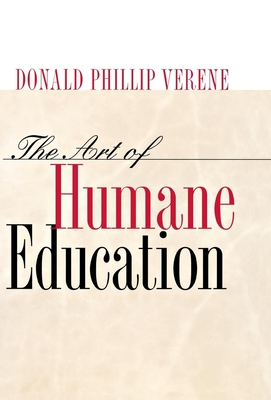
The Art of Humane Education: A Passion for Resistance:
| AUTHOR | Verene, Donald Phillip |
| PUBLISHER | Cornell University Press (07/30/2002) |
| PRODUCT TYPE | Hardcover (Hardcover) |
In The Art of Humane Education, Donald Phillip Verene presents a new statement of the classical and humanist ideals that he believes should guide education in the liberal arts and sciences. These ideals are lost, he contends, in the corporate atmosphere of the contemporary university, with its emphasis on administration, faculty careerism, and student performance. Verene addresses questions of how and what to teach and offers practical suggestions for the conduct of class sessions, the relationship between teacher and student, the interpretation of texts, and the meaning and use of a canon of great books.In sharp contrast to the current tendency toward specialization, Verene considers the aim of college education to be self-knowledge pursued through study of all fields of thought. Education, in his view, must be based on acquisition of the arts of reading, writing, and thinking. He regards the class lecture as a form of oratory that should be presented in accordance with the well-known principles of rhetoric. The Art of Humane Education, styled as a series of letters, makes the author's original and practical ideas very clear. In this elegant book, Verene explores the full range of issues surrounding humane education.On the humanities: "Despite Descartes, the study of humane letters has remained, but it is always in danger of passing out of the curriculum. It remains a beggar who will not quite leave the premises."On teaching: "Like oratory, teaching requires a natural gift, but it is also an art which, like all the other humane arts, can be learned only mimetically.... As some are born tone-deaf and cannot be musical, there are those who can never teach. But most if they wish have some aptitude for it, and this aptitude can be developed into an art."On teachers: "Teachers motivated by eloquence attempt to speak wholly on a subject, since the whole is where its life is. Teachers not motivated by eloquence tend to be either dull or comedic. The dull teacher may have knowledge but have no true language for it.... The comedic teacher is shallow and a menace to the subject matter."On administrators: "Administration is never content simply to concern itself with the pure business of the university, paying its bills, maintaining its buildings. It sees itself as necessary in order for the process between teacher and student to go on. But it is a process that it constantly interrupts.... Administrators, however, should not be taken too seriously."Although sharply critical of many aspects of the modern university and of many currents within the humanities, The Art of Humane Education remains at heart a ringing endorsement of the high humanist tradition and its continuing relevance to the institutions of teaching and learning.
In The Art of Humane Education, Donald Phillip Verene presents a new statement of the classical and humanist ideals that he believes should guide education in the liberal arts and sciences. These ideals are lost, he contends, in the corporate atmosphere of the contemporary university, with its emphasis on administration, faculty careerism, and student performance. Verene addresses questions of how and what to teach and offers practical suggestions for the conduct of class sessions, the relationship between teacher and student, the interpretation of texts, and the meaning and use of a canon of great books.In sharp contrast to the current tendency toward specialization, Verene considers the aim of college education to be self-knowledge pursued through study of all fields of thought. Education, in his view, must be based on acquisition of the arts of reading, writing, and thinking. He regards the class lecture as a form of oratory that should be presented in accordance with the well-known principles of rhetoric. The Art of Humane Education, styled as a series of letters, makes the author's original and practical ideas very clear. In this elegant book, Verene explores the full range of issues surrounding humane education.On the humanities: "Despite Descartes, the study of humane letters has remained, but it is always in danger of passing out of the curriculum. It remains a beggar who will not quite leave the premises."On teaching: "Like oratory, teaching requires a natural gift, but it is also an art which, like all the other humane arts, can be learned only mimetically.... As some are born tone-deaf and cannot be musical, there are those who can never teach. But most if they wish have some aptitude for it, and this aptitude can be developed into an art."On teachers: "Teachers motivated by eloquence attempt to speak wholly on a subject, since the whole is where its life is. Teachers not motivated by eloquence tend to be either dull or comedic. The dull teacher may have knowledge but have no true language for it.... The comedic teacher is shallow and a menace to the subject matter."On administrators: "Administration is never content simply to concern itself with the pure business of the university, paying its bills, maintaining its buildings. It sees itself as necessary in order for the process between teacher and student to go on. But it is a process that it constantly interrupts.... Administrators, however, should not be taken too seriously."Although sharply critical of many aspects of the modern university and of many currents within the humanities, The Art of Humane Education remains at heart a ringing endorsement of the high humanist tradition and its continuing relevance to the institutions of teaching and learning.