
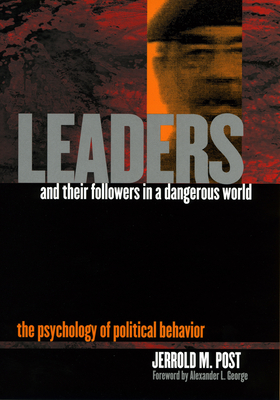
Leaders and Their Followers in a Dangerous World: The Psychology of Political Behavior
| AUTHOR | George, Alexander; George, Alexander; Post, Jerrold M. |
| PUBLISHER | Cornell University Press (04/15/2004) |
| PRODUCT TYPE | Hardcover (Hardcover) |
"Post is a pioneer in the field of political-personality profiling. He may be the only psychiatrist who has specialized in the self-esteem problems of both Osama bin Laden and Saddam Hussein."--The New Yorker "Policy specialists and academic scholars have long agreed that for U.S. leaders to deal effectively with other actors in the international arena, they need images of their adversaries. Leaders must try to see events, and, indeed, their own behavior, from the perspective of opponents.... Faulty images are a source of misperceptions and miscalculations that have often led to major errors in policy, avoidable catastrophes, and missed opportunities. History supplies all too many examples."--from the ForewordWhat impels leaders to lead and followers to follow? How did Osama bin Laden, the son of a multibillionaire construction magnate in Saudi Arabia, become the world's number-one terrorist? What are the psychological foundations of man's inhumanity to man, ethnic cleansing, and genocide? Jerrold M. Post contends that such questions can be answered only through an understanding of the psychological foundations of leader personality and political behavior.Post was founding director of the Center for the Analysis of Personality and Political Behavior for the CIA. He developed the political personality profiles of Menachem Begin and Anwar Sadat for President Jimmy Carter's use at the Camp David talks and initiated the U.S. government's research program on the psychology of political terrorism. He was awarded the Intelligence Medal of Merit in 1979 for his leadership of the center.In this book, he draws on psychological and personality theories, as well as interviews with individual terrorists and those who have interacted with particular leaders, to discuss a range of issues: the effects of illness and age on a leader's political behavior; narcissism and the relationship between followers and a charismatic leader; the impact of crisis-induced stress on policymakers; the mind of the terrorist, with a consideration of "killing in the name of God"; and the need for enemies and the rise of ethnic conflict and terrorism in the post-Cold War environment. The leaders he discusses include Fidel Castro, Osama bin Laden, Saddam Hussein, Kim Jong Il, and Slobodan Milosevic.
"Post is a pioneer in the field of political-personality profiling. He may be the only psychiatrist who has specialized in the self-esteem problems of both Osama bin Laden and Saddam Hussein."--The New Yorker "Policy specialists and academic scholars have long agreed that for U.S. leaders to deal effectively with other actors in the international arena, they need images of their adversaries. Leaders must try to see events, and, indeed, their own behavior, from the perspective of opponents.... Faulty images are a source of misperceptions and miscalculations that have often led to major errors in policy, avoidable catastrophes, and missed opportunities. History supplies all too many examples."--from the ForewordWhat impels leaders to lead and followers to follow? How did Osama bin Laden, the son of a multibillionaire construction magnate in Saudi Arabia, become the world's number-one terrorist? What are the psychological foundations of man's inhumanity to man, ethnic cleansing, and genocide? Jerrold M. Post contends that such questions can be answered only through an understanding of the psychological foundations of leader personality and political behavior.Post was founding director of the Center for the Analysis of Personality and Political Behavior for the CIA. He developed the political personality profiles of Menachem Begin and Anwar Sadat for President Jimmy Carter's use at the Camp David talks and initiated the U.S. government's research program on the psychology of political terrorism. He was awarded the Intelligence Medal of Merit in 1979 for his leadership of the center.In this book, he draws on psychological and personality theories, as well as interviews with individual terrorists and those who have interacted with particular leaders, to discuss a range of issues: the effects of illness and age on a leader's political behavior; narcissism and the relationship between followers and a charismatic leader; the impact of crisis-induced stress on policymakers; the mind of the terrorist, with a consideration of "killing in the name of God"; and the need for enemies and the rise of ethnic conflict and terrorism in the post-Cold War environment. The leaders he discusses include Fidel Castro, Osama bin Laden, Saddam Hussein, Kim Jong Il, and Slobodan Milosevic.