
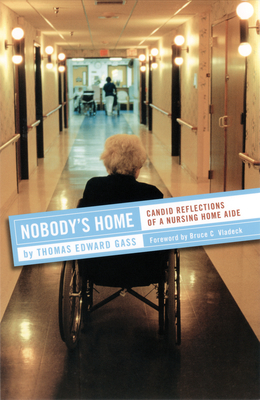
Nobody's Home: Candid Reflections of a Nursing Home Aide
| AUTHOR | Gass, Thomas Edward; Vladeck, Bruce C. |
| PUBLISHER | ILR Press (07/18/2005) |
| PRODUCT TYPE | Paperback (Paperback) |
"At present nursing homes are designed... like outmoded zoos. Residents are kept in small rooms, emotionally isolated. Occasionally they are visited by family members who reach through the bars and offer them treats. Aides keep their bodies clean and presentable.... America invests huge amounts of money to maintain the body while leaving the person to languish, cut off from all they love."--From Nobody's Home
After caring for his mother at the end of her life, Thomas Edward Gass felt drawn to serve the elderly. He took a job as a nursing home aide but was not prepared for the reality that he found at his new place of employment, a for-profit long-term-care facility. In a book that is by turns chilling and graphic, poignant and funny, Gass describes America's system of warehousing its oldest citizens.
Gass brings the reader into the sterile home with its flat metal roof and concrete block walls. Like an industrial park complex, it is clean, efficient, and functional. He is blunt about the institution's goal: keep those faint hearts pumping and the life savings and Medicaid dollars rolling in. With 130 beds in the facility, the owner grosses about three million dollars annually. As a relatively well-paid aide, Gass made $6.90 an hour.
Seventeen of the twenty-six residents on Gass's hall were incontinent, and much of his initiation to the work was learning to care for them in the most intimate ways. One of the many challenges was the limited time that he had available for each of his charges--17.3 minutes per day by his calculation. Even as he learned to ignore all but the most pressing demands of the residents, he discovered the remarkable lengths to which aides and their patients will go to relieve the constant ache of loneliness at the nursing home.
With Americans living longer than ever before, elder care is among the fastest growing occupations. This book makes clear that there is a systemic conflict between profit and extent of care. Instead of controlling costs and maximizing profits, what if long-term care focused on our basic need to lead meaningful and connected lives until our deaths? What if staff members dropped the feigned hope of forestalling the inevitable and concentrated on making their charges comfortable and respected? These and other questions raised by this powerful book will cause Americans to rethink how nursing homes are run, staffed, and financed--as well as the circumstances under which we hope to meet our end.
"At present nursing homes are designed... like outmoded zoos. Residents are kept in small rooms, emotionally isolated. Occasionally they are visited by family members who reach through the bars and offer them treats. Aides keep their bodies clean and presentable.... America invests huge amounts of money to maintain the body while leaving the person to languish, cut off from all they love."--From Nobody's Home
After caring for his mother at the end of her life, Thomas Edward Gass felt drawn to serve the elderly. He took a job as a nursing home aide but was not prepared for the reality that he found at his new place of employment, a for-profit long-term-care facility. In a book that is by turns chilling and graphic, poignant and funny, Gass describes America's system of warehousing its oldest citizens.
Gass brings the reader into the sterile home with its flat metal roof and concrete block walls. Like an industrial park complex, it is clean, efficient, and functional. He is blunt about the institution's goal: keep those faint hearts pumping and the life savings and Medicaid dollars rolling in. With 130 beds in the facility, the owner grosses about three million dollars annually. As a relatively well-paid aide, Gass made $6.90 an hour.
Seventeen of the twenty-six residents on Gass's hall were incontinent, and much of his initiation to the work was learning to care for them in the most intimate ways. One of the many challenges was the limited time that he had available for each of his charges--17.3 minutes per day by his calculation. Even as he learned to ignore all but the most pressing demands of the residents, he discovered the remarkable lengths to which aides and their patients will go to relieve the constant ache of loneliness at the nursing home.
With Americans living longer than ever before, elder care is among the fastest growing occupations. This book makes clear that there is a systemic conflict between profit and extent of care. Instead of controlling costs and maximizing profits, what if long-term care focused on our basic need to lead meaningful and connected lives until our deaths? What if staff members dropped the feigned hope of forestalling the inevitable and concentrated on making their charges comfortable and respected? These and other questions raised by this powerful book will cause Americans to rethink how nursing homes are run, staffed, and financed--as well as the circumstances under which we hope to meet our end.