
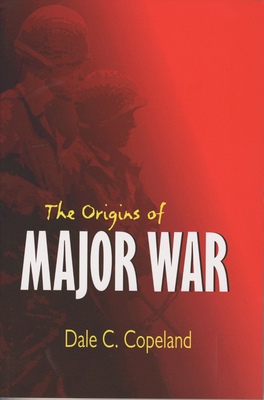
Origins of Major War
| AUTHOR | Copeland, Dale C. |
| PUBLISHER | Cornell University Press (08/15/2001) |
| PRODUCT TYPE | Paperback (Paperback) |
One of the most important questions of human existence is what drives nations to war--especially massive, system-threatening war. Much military history focuses on the who, when, and where of war. In this riveting book, Dale C. Copeland brings attention to bear on why governments make decisions that lead to, sustain, and intensify conflicts.Copeland presents detailed historical narratives of several twentieth-century cases, including World War I, World War II, and the Cold War. He highlights instigating factors that transcend individual personalities, styles of government, geography, and historical context to reveal remarkable consistency across several major wars usually considered dissimilar. The result is a series of challenges to established interpretive positions and provocative new readings of the causes of conflict.Classical realists and neorealists claim that dominant powers initiate war. Hegemonic stability realists believe that wars are most often started by rising states. Copeland offers an approach stronger in explanatory power and predictive capacity than these three brands of realism: he examines not only the power resources but the shifting power differentials of states. He specifies more precisely the conditions under which state decline leads to conflict, drawing empirical support from the critical cases of the twentieth century as well as major wars spanning from ancient Greece to the Napoleonic Wars.
One of the most important questions of human existence is what drives nations to war--especially massive, system-threatening war. Much military history focuses on the who, when, and where of war. In this riveting book, Dale C. Copeland brings attention to bear on why governments make decisions that lead to, sustain, and intensify conflicts.Copeland presents detailed historical narratives of several twentieth-century cases, including World War I, World War II, and the Cold War. He highlights instigating factors that transcend individual personalities, styles of government, geography, and historical context to reveal remarkable consistency across several major wars usually considered dissimilar. The result is a series of challenges to established interpretive positions and provocative new readings of the causes of conflict.Classical realists and neorealists claim that dominant powers initiate war. Hegemonic stability realists believe that wars are most often started by rising states. Copeland offers an approach stronger in explanatory power and predictive capacity than these three brands of realism: he examines not only the power resources but the shifting power differentials of states. He specifies more precisely the conditions under which state decline leads to conflict, drawing empirical support from the critical cases of the twentieth century as well as major wars spanning from ancient Greece to the Napoleonic Wars.