
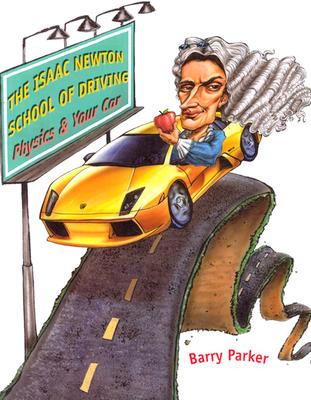
The Isaac Newton School of Driving: Physics and Your Car
| AUTHOR | Parker, Barry |
| PUBLISHER | Johns Hopkins University Press (09/16/2003) |
| PRODUCT TYPE | Hardcover (Hardcover) |
For some people, driving is an art; for others, it's a science. At the Isaac Newton School of Driving, though, every car is a laboratory on wheels and every drive an exciting journey into the world of physics. As explained by renowned science writer and physics professor Barry Parker--whose father was a car mechanic and garage owner--almost every aspect of driving involves physics. A car's performance and handling relies on fundamental concepts such as force, momentum, and energy. Its ignition system depends on the principles of electricity and magnetism. Braking relies on friction--yet another basic scientific concept--and if the brakes fail, the resulting damage, too, can be predicted using physics.
Parker's first lesson describes the basic physics of driving: speed and acceleration; why you get thrown forward while braking or outward while turning; and why car advertisements boast about horsepower and torque. He goes on to discuss the thermodynamics of engines, and how they can be more fuel efficient; and what friction and traction are and how they keep a car's tires on the road, whether it's dry, wet, or icy. He also describes how simple laws of physics enable scientists to design aerodynamic cars and high-tech steering systems. Parker then explores the high-performance physics of auto racing, outlines how traffic accidents are reconstructed by police, uses chaos theory to explain why traffic jams happen, and describes what cars of the future might look like. Whether you drive a Pacer or a Porsche, The Isaac Newton School of Driving offers better--and better-informed--driving through physics.
For some people, driving is an art; for others, it's a science. At the Isaac Newton School of Driving, though, every car is a laboratory on wheels and every drive an exciting journey into the world of physics. As explained by renowned science writer and physics professor Barry Parker--whose father was a car mechanic and garage owner--almost every aspect of driving involves physics. A car's performance and handling relies on fundamental concepts such as force, momentum, and energy. Its ignition system depends on the principles of electricity and magnetism. Braking relies on friction--yet another basic scientific concept--and if the brakes fail, the resulting damage, too, can be predicted using physics.
Parker's first lesson describes the basic physics of driving: speed and acceleration; why you get thrown forward while braking or outward while turning; and why car advertisements boast about horsepower and torque. He goes on to discuss the thermodynamics of engines, and how they can be more fuel efficient; and what friction and traction are and how they keep a car's tires on the road, whether it's dry, wet, or icy. He also describes how simple laws of physics enable scientists to design aerodynamic cars and high-tech steering systems. Parker then explores the high-performance physics of auto racing, outlines how traffic accidents are reconstructed by police, uses chaos theory to explain why traffic jams happen, and describes what cars of the future might look like. Whether you drive a Pacer or a Porsche, The Isaac Newton School of Driving offers better--and better-informed--driving through physics.