
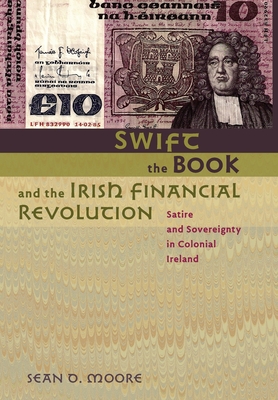
Swift, the Book, and the Irish Financial Revolution: Satire and Sovereignty in Colonial Ireland
| AUTHOR | Moore, Sean D. |
| PUBLISHER | Johns Hopkins University Press (09/30/2010) |
| PRODUCT TYPE | Hardcover (Hardcover) |
Winner, 2010 Donald Murphy Prize for a Distinguished First Book, American Conference on Irish Studies
Renowned as one of the most brilliant satirists ever, Jonathan Swift has long fascinated Hibernophiles beyond the shores of the Emerald Isle. Sean Moore's examination of Swift's writings and the economics behind the distribution of his work elucidates the humorist's crucial role in developing a renewed sense of nationalism among the Irish during the eighteenth century.
Taking Swift's Irish satires, such as A Modest Proposal and the Drapier's Letters, as examples of anticolonial discourse, Moore unpacks the author's carefully considered published words and his deliberate drive to liberate the Dublin publishing industry from England's shadow to argue that the writer was doing nothing less than creating a national print media. He points to the actions of Anglo-Irish colonial subjects at the outset of Britain's financial revolution; inspired by Swift's dream of a sovereign Ireland, these men and women harnessed the printing press to disseminate ideas of cultural autonomy and defend the country's economic rights. Doing so, Moore contends, imbued the island with a sense of Irishness that led to a feeling of independence from England and ultimately gave the Irish a surprising degree of financial autonomy.
Applying postcolonial, new economic, and book history approaches to eighteenth-century studies, Swift, the Book, and the Irish Financial Revolution effectively links the era's critiques of empire to the financial and legal motives for decolonization. Scholars of colonialism, postcolonialism, Irish studies, Atlantic studies, Swift, and the history of the book will find Moore's eye-opening arguments original and compelling.
Winner, 2010 Donald Murphy Prize for a Distinguished First Book, American Conference on Irish Studies
Renowned as one of the most brilliant satirists ever, Jonathan Swift has long fascinated Hibernophiles beyond the shores of the Emerald Isle. Sean Moore's examination of Swift's writings and the economics behind the distribution of his work elucidates the humorist's crucial role in developing a renewed sense of nationalism among the Irish during the eighteenth century.
Taking Swift's Irish satires, such as A Modest Proposal and the Drapier's Letters, as examples of anticolonial discourse, Moore unpacks the author's carefully considered published words and his deliberate drive to liberate the Dublin publishing industry from England's shadow to argue that the writer was doing nothing less than creating a national print media. He points to the actions of Anglo-Irish colonial subjects at the outset of Britain's financial revolution; inspired by Swift's dream of a sovereign Ireland, these men and women harnessed the printing press to disseminate ideas of cultural autonomy and defend the country's economic rights. Doing so, Moore contends, imbued the island with a sense of Irishness that led to a feeling of independence from England and ultimately gave the Irish a surprising degree of financial autonomy.
Applying postcolonial, new economic, and book history approaches to eighteenth-century studies, Swift, the Book, and the Irish Financial Revolution effectively links the era's critiques of empire to the financial and legal motives for decolonization. Scholars of colonialism, postcolonialism, Irish studies, Atlantic studies, Swift, and the history of the book will find Moore's eye-opening arguments original and compelling.