
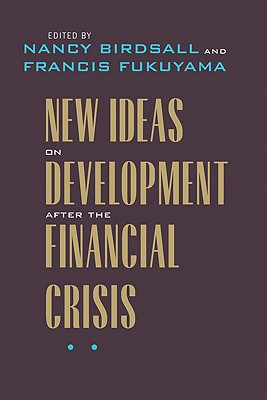
New Ideas on Development After the Financial Crisis
| PUBLISHER | Johns Hopkins University Press (04/21/2011) |
| PRODUCT TYPE | Hardcover (Hardcover) |
The global financial crisis of 2008-9 has changed the way people around the world think about development. The market-friendly, lightly regulated model of capitalism promoted by the United States is now at risk, and development thinking worldwide is at something of an impasse. Editors Nancy Birdsall and Francis Fukuyama bring together leading scholars to explore the implications of the global financial crisis on existing and future development strategies.
In addressing this issue, the contributors contemplate three central questions: What effect has the crisis had on current ideas in development thinking? How has it affected and how will it affect economic policy and political realities in Latin America and Asia, including China and India? Will the financial collapse reinforce shifts in geopolitical power and influence, and in what form? Essays answering these questions identify themes that are essential as economic and political leaders address future challenges of development.
To help move beyond this time of global economic turmoil, the contributors--the foremost minds in the field of international development--offer innovative ideas about stabilizing the international economy and promoting global development strategies.
Contributors: Nancy Birdsall, Center for Global Development; Michael Clemens, Center for Global Development; Kemal Dervi?, Brookings Institution; Larry Diamond, Stanford University; Francis Fukuyama, Stanford University; Peter S. Heller, Johns Hopkins University; Yasheng Huang, Massachusetts Institute of Technology; Justin Yifu Lin, World Bank; José Antonio Ocampo, Columbia University; Mitchell A. Orenstein, Johns Hopkins University; Minxin Pei, Claremont McKenna College; Lant Pritchett, Harvard University; Liliana Rojas-Suarez, Center for Global Development; Arvid Subramanian, Johns Hopkins University
The global financial crisis of 2008-9 has changed the way people around the world think about development. The market-friendly, lightly regulated model of capitalism promoted by the United States is now at risk, and development thinking worldwide is at something of an impasse. Editors Nancy Birdsall and Francis Fukuyama bring together leading scholars to explore the implications of the global financial crisis on existing and future development strategies.
In addressing this issue, the contributors contemplate three central questions: What effect has the crisis had on current ideas in development thinking? How has it affected and how will it affect economic policy and political realities in Latin America and Asia, including China and India? Will the financial collapse reinforce shifts in geopolitical power and influence, and in what form? Essays answering these questions identify themes that are essential as economic and political leaders address future challenges of development.
To help move beyond this time of global economic turmoil, the contributors--the foremost minds in the field of international development--offer innovative ideas about stabilizing the international economy and promoting global development strategies.
Contributors: Nancy Birdsall, Center for Global Development; Michael Clemens, Center for Global Development; Kemal Dervi?, Brookings Institution; Larry Diamond, Stanford University; Francis Fukuyama, Stanford University; Peter S. Heller, Johns Hopkins University; Yasheng Huang, Massachusetts Institute of Technology; Justin Yifu Lin, World Bank; José Antonio Ocampo, Columbia University; Mitchell A. Orenstein, Johns Hopkins University; Minxin Pei, Claremont McKenna College; Lant Pritchett, Harvard University; Liliana Rojas-Suarez, Center for Global Development; Arvid Subramanian, Johns Hopkins University