
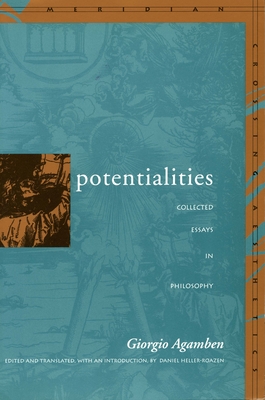
Potentialities: Collected Essays
| AUTHOR | Heller-Roazen, Daniel; Agamben, Giorgio |
| PUBLISHER | Stanford University Press (01/01/2000) |
| PRODUCT TYPE | Paperback (Paperback) |
This book collects fifteen major philosophical essays written over a period of more than twenty years by acclaimed Italian philosopher Giorgio Agamben. The volume opens with an introduction in which the editor situates Agamben's work with respect to both the history of philosophy and contemporary European thought. The essays that follow articulate a series of theoretical confrontations with privileged figures in the history of philosophy, politics, and criticism, from Plato to Spinoza, Aristotle to Deleuze, Carl Schmitt to Benjamin, Hegel to Aby Warburg, and Heidegger to Derrida. Three fundamental concepts organize the collection as a whole: language, in the sense not of particular statements but rather the very taking place of speech, the pure fact of language's existence; history, as it appears from a perspective in which tradition, transmission, and memory reach their messianic fulfillment; and potentiality, understood as a fundamental problem of metaphysics, ethics, and the philosophy of language. All these topics converge in the final part of the book, in which Agamben offers an extensive reading of Melville's short story "Bartleby the Scrivener" as a work that puts potentiality and actuality, possibility and reality, in an altogether new light.
The essays consider figures in the history of philosophy (such as Plato, Plotinus, Spinoza, and Hegel) and twentieth-century thought (most notably Walter Benjamin, but also Heidegger, Derrida, Deleuze, the historian Aby Warburg, and the linguist J.-C. Milner). They also examine several general topics that have always been of central concern to Agamben: the relation of linguistic and metaphysical categories; messianism in Islamic, Jewish, and Christian theology; and the state and future of contemporary politics. Despite the diversity of the texts collected here, they show a consistent concern for a set of overriding philosophical themes concerning language, history, and potentiality.
In the first part of the book, Agamben brings philosophical texts of Plato and Benjamin, the literary criticism of Max Kommerell, and the linguistic studies of J.-C. Milner to bear upon a question that exposes each discipline to a limit at which the possibility of language itself is at stake. The essays in the second part concern a body of texts that deal with the structure of history and historical reflection, including the idea of the end of history in Jewish and Christian messianism, as well as in Hegel, Benjamin, and Aby Warburg. In the third part, the issues confronted in the first and second parts are shown to be best grasped as issues of potentiality. Agamben argues that language and history are structures of potentiality and can be most fully understood on the basis of the Aristotelian theory of dynamis and its medieval elaborations. The fourth part is an extensive essay on Herman Melville's short story "Bartleby, the Scrivener."
This book collects fifteen major philosophical essays written over a period of more than twenty years by acclaimed Italian philosopher Giorgio Agamben. The volume opens with an introduction in which the editor situates Agamben's work with respect to both the history of philosophy and contemporary European thought. The essays that follow articulate a series of theoretical confrontations with privileged figures in the history of philosophy, politics, and criticism, from Plato to Spinoza, Aristotle to Deleuze, Carl Schmitt to Benjamin, Hegel to Aby Warburg, and Heidegger to Derrida. Three fundamental concepts organize the collection as a whole: language, in the sense not of particular statements but rather the very taking place of speech, the pure fact of language's existence; history, as it appears from a perspective in which tradition, transmission, and memory reach their messianic fulfillment; and potentiality, understood as a fundamental problem of metaphysics, ethics, and the philosophy of language. All these topics converge in the final part of the book, in which Agamben offers an extensive reading of Melville's short story "Bartleby the Scrivener" as a work that puts potentiality and actuality, possibility and reality, in an altogether new light.