
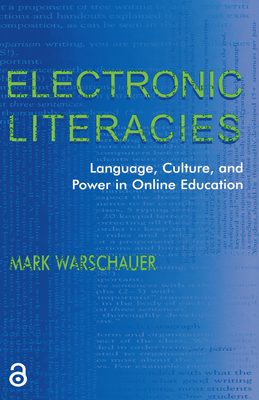
Electronic Literacies: Language, Culture, and Power in Online Education
| AUTHOR | Warschauer, Mark |
| PUBLISHER | Routledge (10/01/1998) |
| PRODUCT TYPE | Paperback (Paperback) |
Electronic Literacies is an insightful study of the challenges and contradictions that arise as culturally and linguistically diverse learners engage in new language and literacy practices in online environments.
The role of the Internet in changing literacy and education has been a topic of much speculation, but very little concrete research. This book is one of the first attempts to document the role of the Internet and other new digital technologies in the development of language and literacy. Warschauer looks at how the nature of reading and writing is changing, and how those changes are being addressed in the classroom. His focus is on the experiences of culturally and linguistically diverse learners who are at special risk of being marginalized from the information society. Based on a two-year ethnographic study of the uses of the Internet in four language and writing classrooms in the state of Hawai'i--a Hawaiian language class of Native Hawaiian students seeking to revitalize their language and culture; an ESL class of students from Pacific Island and Latin American countries; an ESL class of students from Asian countries; and an English composition class of working-class students from diverse ethnic backgrounds--the book includes data from interviews with students and teachers, classroom observations, and analysis of student texts. This rich ethnographic data is combined with theories from a broad range of disciplines to develop conclusions about the relationship of technology to language, literacy, education, and culture. Central to Warschauer's discussion and conclusions is how contradictions of language, culture, and class affect the impact of Internet-based education. While Hawai'i is a special place, the issues confronted here are similar in many ways to those that exist throughout the United States and many other countries: How to provide culturally and linguistically diverse students traditionally on the educational and technological margins with the literacies they need to fully participate in public, community, and economic life in the 21st century.The Open Access version of this book, available at http: //www.taylorfrancis.com, has been made available under a Creative Commons Attribution-Non Commercial-No Derivatives (CC-BY-NC-ND) 4.0 license.
Electronic Literacies is an insightful study of the challenges and contradictions that arise as culturally and linguistically diverse learners engage in new language and literacy practices in online environments.
The role of the Internet in changing literacy and education has been a topic of much speculation, but very little concrete research. This book is one of the first attempts to document the role of the Internet and other new digital technologies in the development of language and literacy. Warschauer looks at how the nature of reading and writing is changing, and how those changes are being addressed in the classroom. His focus is on the experiences of culturally and linguistically diverse learners who are at special risk of being marginalized from the information society. Based on a two-year ethnographic study of the uses of the Internet in four language and writing classrooms in the state of Hawai'i--a Hawaiian language class of Native Hawaiian students seeking to revitalize their language and culture; an ESL class of students from Pacific Island and Latin American countries; an ESL class of students from Asian countries; and an English composition class of working-class students from diverse ethnic backgrounds--the book includes data from interviews with students and teachers, classroom observations, and analysis of student texts. This rich ethnographic data is combined with theories from a broad range of disciplines to develop conclusions about the relationship of technology to language, literacy, education, and culture. Central to Warschauer's discussion and conclusions is how contradictions of language, culture, and class affect the impact of Internet-based education. While Hawai'i is a special place, the issues confronted here are similar in many ways to those that exist throughout the United States and many other countries: How to provide culturally and linguistically diverse students traditionally on the educational and technological margins with the literacies they need to fully participate in public, community, and economic life in the 21st century.The Open Access version of this book, available at http: //www.taylorfrancis.com, has been made available under a Creative Commons Attribution-Non Commercial-No Derivatives (CC-BY-NC-ND) 4.0 license.