
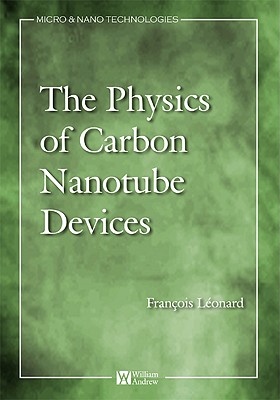
Physics of Carbon Nanotube Devices
| AUTHOR | Leonard, Francois |
| PUBLISHER | William Andrew (08/01/2008) |
| PRODUCT TYPE | Hardcover (Hardcover) |
Description
Possibly the most impactful material in the nanotechnology arena, carbon nanotubes have spurred a tremendous amount of scientific research and development. Their superior mechanical and chemical robustness makes them easily manipulable and allows for the assembly of various types of devices, including electronic, electromechanical, opto-electronic and sensing devices. In the field of nanotube devices, however, concepts that describe the properties of conventional devices do not apply. Carbon nanotube devices behave much differently from those using traditional materials, and offer entirely new functionality. This book - designed for researchers, engineers and graduate students alike - bridges the experimental and theoretical aspects of carbon nanotube devices. It emphasizes and explains the underlying physics that govern their working principles, including applications in electronics, nanoelectromechanical systems, field emission, optoelectronics and sensing. Other topics include: electrical contacts, p-n junctions, transistors, ballistic transport, field emission, oscillators, rotational actuators, electron-phonon scattering, photoconductivity, and light emission. Many of the aspects discussed here differ significantly from those learned in books or traditional materials, and are essential for the future development of carbon nanotube technology. - Bridges experimental and theoretical aspects of carbon nanotube devices, focusing on the underlying physics that govern their working principles
- Explains applications in electronics, nanoelectromechanical systems, field emission, optoelectronics and sensing.
- Other topics include: electrical contacts, p-n junctions, transistors, ballistic transport, field emission, oscillators, rotational actuators, electron-phonon scattering, photoconductivity, and light emission.
- Covers aspects that significantly differ from those learned in traditional materials, yet are essential for future advancement of carbon nanotube technology.
- Explains applications in electronics, nanoelectromechanical systems, field emission, optoelectronics and sensing.
- Other topics include: electrical contacts, p-n junctions, transistors, ballistic transport, field emission, oscillators, rotational actuators, electron-phonon scattering, photoconductivity, and light emission.
- Covers aspects that significantly differ from those learned in traditional materials, yet are essential for future advancement of carbon nanotube technology.
Show More
Product Format
Product Details
ISBN-13:
9780815515739
ISBN-10:
0815515731
Binding:
Hardback or Cased Book (Sewn)
Content Language:
English
More Product Details
Page Count:
300
Carton Quantity:
22
Product Dimensions:
7.20 x 0.90 x 10.10 inches
Weight:
1.80 pound(s)
Feature Codes:
Bibliography,
Index,
Table of Contents,
Illustrated
Country of Origin:
US
Subject Information
BISAC Categories
Technology & Engineering | Engineering (General)
Technology & Engineering | Nanotechnology & MEMS
Technology & Engineering | Materials Science - General
Dewey Decimal:
669.028
Library of Congress Control Number:
2008026529
Descriptions, Reviews, Etc.
publisher marketing
Possibly the most impactful material in the nanotechnology arena, carbon nanotubes have spurred a tremendous amount of scientific research and development. Their superior mechanical and chemical robustness makes them easily manipulable and allows for the assembly of various types of devices, including electronic, electromechanical, opto-electronic and sensing devices. In the field of nanotube devices, however, concepts that describe the properties of conventional devices do not apply. Carbon nanotube devices behave much differently from those using traditional materials, and offer entirely new functionality. This book - designed for researchers, engineers and graduate students alike - bridges the experimental and theoretical aspects of carbon nanotube devices. It emphasizes and explains the underlying physics that govern their working principles, including applications in electronics, nanoelectromechanical systems, field emission, optoelectronics and sensing. Other topics include: electrical contacts, p-n junctions, transistors, ballistic transport, field emission, oscillators, rotational actuators, electron-phonon scattering, photoconductivity, and light emission. Many of the aspects discussed here differ significantly from those learned in books or traditional materials, and are essential for the future development of carbon nanotube technology. - Bridges experimental and theoretical aspects of carbon nanotube devices, focusing on the underlying physics that govern their working principles
- Explains applications in electronics, nanoelectromechanical systems, field emission, optoelectronics and sensing.
- Other topics include: electrical contacts, p-n junctions, transistors, ballistic transport, field emission, oscillators, rotational actuators, electron-phonon scattering, photoconductivity, and light emission.
- Covers aspects that significantly differ from those learned in traditional materials, yet are essential for future advancement of carbon nanotube technology.
- Explains applications in electronics, nanoelectromechanical systems, field emission, optoelectronics and sensing.
- Other topics include: electrical contacts, p-n junctions, transistors, ballistic transport, field emission, oscillators, rotational actuators, electron-phonon scattering, photoconductivity, and light emission.
- Covers aspects that significantly differ from those learned in traditional materials, yet are essential for future advancement of carbon nanotube technology.
Show More
List Price $185.00
Your Price
$183.15