
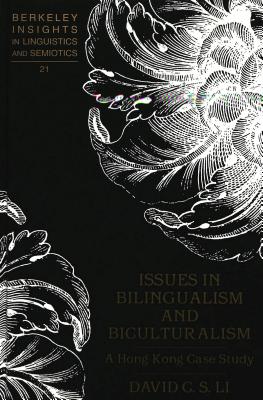
Issues in Bilingualism and Biculturalism: A Hong Kong Case Study
| AUTHOR | David Chor Li; Rauch, Irmengard; Li, David C. S. |
| PUBLISHER | Peter Lang Inc., International Academic Publi (11/01/1996) |
| PRODUCT TYPE | Hardcover (Hardcover) |
Description
Issues in Bilingualism and Biculturalism describes the nature and extent of code-mixing in Hong Kong in the 1990s. It is mainly based on written data obtained from the local Chinese press collected systematically over a period of two years since late 1992. While previous studies on code-mixing between Cantonese and English in Hong Kong tend to emphasize sociolinguistic motivations, this book presents evidence that much of the code-mixing behaviour, be it in print or in speech, may be traced back to linguistic motivations at work resulting from sustained contact between Cantonese, modern standard Chinese and increasingly, English. This study further argues that, largely as a correlate of biculturalism, code-mixing - which is indicative of linguistic convergence in the mind of the average Hong Kong bilingual - is simply unstoppable, given that the norms prescribed for the written standard varieties of Chinese and English deviate considerably from those of the vernacular Cantonese.
Show More
Product Format
Product Details
ISBN-13:
9780820430362
ISBN-10:
0820430366
Binding:
Hardback or Cased Book (Sewn)
Content Language:
English
More Product Details
Page Count:
208
Carton Quantity:
0
Feature Codes:
Bibliography,
Index,
Illustrated
Country of Origin:
US
Subject Information
BISAC Categories
Foreign Language Study | Chinese
Foreign Language Study | English as a Second Language
Foreign Language Study | Miscellaneous
Dewey Decimal:
495.104
Library of Congress Control Number:
95047141
Descriptions, Reviews, Etc.
publisher marketing
Issues in Bilingualism and Biculturalism describes the nature and extent of code-mixing in Hong Kong in the 1990s. It is mainly based on written data obtained from the local Chinese press collected systematically over a period of two years since late 1992. While previous studies on code-mixing between Cantonese and English in Hong Kong tend to emphasize sociolinguistic motivations, this book presents evidence that much of the code-mixing behaviour, be it in print or in speech, may be traced back to linguistic motivations at work resulting from sustained contact between Cantonese, modern standard Chinese and increasingly, English. This study further argues that, largely as a correlate of biculturalism, code-mixing - which is indicative of linguistic convergence in the mind of the average Hong Kong bilingual - is simply unstoppable, given that the norms prescribed for the written standard varieties of Chinese and English deviate considerably from those of the vernacular Cantonese.
Show More
List Price $74.05
Your Price
$73.31