
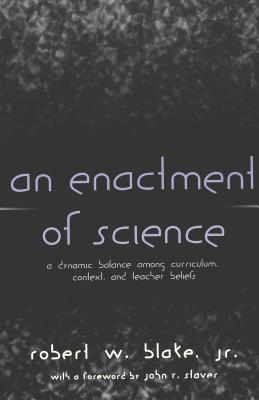
An Enactment of Science: A Dynamic Balance Among Curriculum, Context, and Teacher Beliefs with a Foreword by John R. Staver
| AUTHOR | Blake, Robert W., Jr.; Blake, Robert W., Jr.; Kincheloe, Joe L. et al. |
| PUBLISHER | Lsi Samples (09/05/2000) |
| PRODUCT TYPE | Hardcover (Hardcover) |
Description
An Enactment of Science: A Dynamic Balance Among Curriculum, Context, and Teacher Beliefs examines the specific role of an urban sixth-grade teacher as she engages her students in the learning of science. With a four component model of curriculum enactment (curriculum, context, teacher beliefs, and enactment) as a guiding framework for inquiry, this book addresses an essential question in contemporary science education: Is exemplary science teaching a process of traditional practices, progressive practices, or, an eclectic combination of both, constituting some notion of a middle ground? Also examined is the teacher's explicit process of coaching students in the use of social skills as part of the content of science as she guides students toward successful cooperative group work and collective and individual problem solving.
Robert W. Blake, Jr., suggests that pre-service and in-service teachers may want to evaluate how closely their beliefs about the curriculum, context, and teaching match the reality of their classroom situation with the potential of altering one (the curriculum) or the other (their beliefs) to enhance the enactment of science. Also, explicit teacher modeling of social skills may serve useful for students to act independently of the teacher as they engage in science activities. Finally, teachers may consider their practice a balance between traditional and progressive modes of teaching, finding what is most useful are components from both frameworks.
Robert W. Blake, Jr., suggests that pre-service and in-service teachers may want to evaluate how closely their beliefs about the curriculum, context, and teaching match the reality of their classroom situation with the potential of altering one (the curriculum) or the other (their beliefs) to enhance the enactment of science. Also, explicit teacher modeling of social skills may serve useful for students to act independently of the teacher as they engage in science activities. Finally, teachers may consider their practice a balance between traditional and progressive modes of teaching, finding what is most useful are components from both frameworks.
Show More
Product Format
Product Details
ISBN-13:
9780820451244
ISBN-10:
082045124X
Binding:
Hardback or Cased Book (Unsewn / Adhesive Bound)
Content Language:
English
More Product Details
Page Count:
212
Carton Quantity:
34
Country of Origin:
US
Subject Information
BISAC Categories
Science | Study & Teaching
Science | Aims & Objectives
Science | General
Dewey Decimal:
507.1
Library of Congress Control Number:
2001029120
Descriptions, Reviews, Etc.
publisher marketing
An Enactment of Science: A Dynamic Balance Among Curriculum, Context, and Teacher Beliefs examines the specific role of an urban sixth-grade teacher as she engages her students in the learning of science. With a four component model of curriculum enactment (curriculum, context, teacher beliefs, and enactment) as a guiding framework for inquiry, this book addresses an essential question in contemporary science education: Is exemplary science teaching a process of traditional practices, progressive practices, or, an eclectic combination of both, constituting some notion of a middle ground? Also examined is the teacher's explicit process of coaching students in the use of social skills as part of the content of science as she guides students toward successful cooperative group work and collective and individual problem solving.
Robert W. Blake, Jr., suggests that pre-service and in-service teachers may want to evaluate how closely their beliefs about the curriculum, context, and teaching match the reality of their classroom situation with the potential of altering one (the curriculum) or the other (their beliefs) to enhance the enactment of science. Also, explicit teacher modeling of social skills may serve useful for students to act independently of the teacher as they engage in science activities. Finally, teachers may consider their practice a balance between traditional and progressive modes of teaching, finding what is most useful are components from both frameworks.
Robert W. Blake, Jr., suggests that pre-service and in-service teachers may want to evaluate how closely their beliefs about the curriculum, context, and teaching match the reality of their classroom situation with the potential of altering one (the curriculum) or the other (their beliefs) to enhance the enactment of science. Also, explicit teacher modeling of social skills may serve useful for students to act independently of the teacher as they engage in science activities. Finally, teachers may consider their practice a balance between traditional and progressive modes of teaching, finding what is most useful are components from both frameworks.
Show More
Editor:
Steinberg, Shirley
Shirley R. Steinberg is an Associate Professor of Education and the Program Chair of Graduate Literacy at Brooklyn College. She is the author and editor of many books and articles, including "Multi/Intercultural Conversations: A Reader" and "19 Urban Questions: Teaching in the City".
Show More
List Price $44.00
Your Price
$43.56