
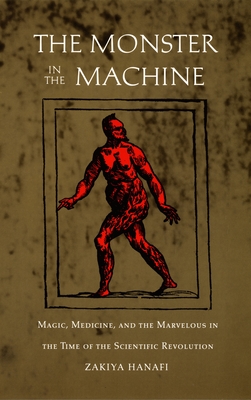
The Monster in the Machine: Magic, Medicine, and the Marvelous in the Time of the Scientific Revolution
| AUTHOR | Hanafi, Zakiya |
| PUBLISHER | Duke University Press (10/25/2000) |
| PRODUCT TYPE | Paperback (Paperback) |
Description
The Monster in the Machine tracks the ways in which human beings were defined in contrast to supernatural and demonic creatures during the time of the Scientific Revolution. Zakiya Hanafi recreates scenes of Italian life and culture from the late sixteenth to the early eighteenth centuries to show how monsters were conceptualized at this particular locale and historical juncture-a period when the sacred was being supplanted by a secular, decidedly nonmagical way of looking at the world.
Noting that the word "monster" is derived from the Latin for "omen" or "warning," Hanafi explores the monster's early identity as a portent or messenger from God. Although monsters have always been considered "whatever we are not," they gradually were tranformed into mechanical devices when new discoveries in science and medicine revealed the mechanical nature of the human body. In analyzing the historical literature of monstrosity, magic, and museum collections, Hanafi uses contemporary theory and the philosophy of technology to illuminate the timeless significance of the monster theme. She elaborates the association between women and the monstrous in medical literature and sheds new light on the work of Vico-particularly his notion of the conatus-by relating it to Vico's own health. By explicating obscure and fascinating texts from such disciplines as medicine and poetics, she invites the reader to the piazzas and pulpits of seventeenth-century Naples, where poets, courtiers, and Jesuit preachers used grotesque figures of speech to captivate audiences with their monstrous wit.
Drawing from a variety of texts from medicine, moral philosophy, and poetics, Hanafi's guided tour through this baroque museum of ideas will interest readers in comparative literature, Italian literature, history of ideas, history of science, art history, poetics, women's studies, and philosophy.
Noting that the word "monster" is derived from the Latin for "omen" or "warning," Hanafi explores the monster's early identity as a portent or messenger from God. Although monsters have always been considered "whatever we are not," they gradually were tranformed into mechanical devices when new discoveries in science and medicine revealed the mechanical nature of the human body. In analyzing the historical literature of monstrosity, magic, and museum collections, Hanafi uses contemporary theory and the philosophy of technology to illuminate the timeless significance of the monster theme. She elaborates the association between women and the monstrous in medical literature and sheds new light on the work of Vico-particularly his notion of the conatus-by relating it to Vico's own health. By explicating obscure and fascinating texts from such disciplines as medicine and poetics, she invites the reader to the piazzas and pulpits of seventeenth-century Naples, where poets, courtiers, and Jesuit preachers used grotesque figures of speech to captivate audiences with their monstrous wit.
Drawing from a variety of texts from medicine, moral philosophy, and poetics, Hanafi's guided tour through this baroque museum of ideas will interest readers in comparative literature, Italian literature, history of ideas, history of science, art history, poetics, women's studies, and philosophy.
Show More
Product Format
Product Details
ISBN-13:
9780822325680
ISBN-10:
0822325683
Binding:
Paperback or Softback (Trade Paperback (Us))
Content Language:
English
More Product Details
Page Count:
288
Carton Quantity:
28
Product Dimensions:
6.00 x 0.82 x 9.18 inches
Weight:
1.07 pound(s)
Feature Codes:
Bibliography,
Index,
Illustrated
Country of Origin:
US
Subject Information
BISAC Categories
Science | History
Science | Philosophy & Social Aspects
Science | Europe - Italy
Dewey Decimal:
306.45
Library of Congress Control Number:
00035458
Descriptions, Reviews, Etc.
jacket back
"A well-researched, engagingly written, rich, and enlightening study."--Deanna Shemek, author of "Ladies Errant: Wayward Women and Social Order in Early Modern Italy"
Show More
publisher marketing
The Monster in the Machine tracks the ways in which human beings were defined in contrast to supernatural and demonic creatures during the time of the Scientific Revolution. Zakiya Hanafi recreates scenes of Italian life and culture from the late sixteenth to the early eighteenth centuries to show how monsters were conceptualized at this particular locale and historical juncture-a period when the sacred was being supplanted by a secular, decidedly nonmagical way of looking at the world.
Noting that the word "monster" is derived from the Latin for "omen" or "warning," Hanafi explores the monster's early identity as a portent or messenger from God. Although monsters have always been considered "whatever we are not," they gradually were tranformed into mechanical devices when new discoveries in science and medicine revealed the mechanical nature of the human body. In analyzing the historical literature of monstrosity, magic, and museum collections, Hanafi uses contemporary theory and the philosophy of technology to illuminate the timeless significance of the monster theme. She elaborates the association between women and the monstrous in medical literature and sheds new light on the work of Vico-particularly his notion of the conatus-by relating it to Vico's own health. By explicating obscure and fascinating texts from such disciplines as medicine and poetics, she invites the reader to the piazzas and pulpits of seventeenth-century Naples, where poets, courtiers, and Jesuit preachers used grotesque figures of speech to captivate audiences with their monstrous wit.
Drawing from a variety of texts from medicine, moral philosophy, and poetics, Hanafi's guided tour through this baroque museum of ideas will interest readers in comparative literature, Italian literature, history of ideas, history of science, art history, poetics, women's studies, and philosophy.
Noting that the word "monster" is derived from the Latin for "omen" or "warning," Hanafi explores the monster's early identity as a portent or messenger from God. Although monsters have always been considered "whatever we are not," they gradually were tranformed into mechanical devices when new discoveries in science and medicine revealed the mechanical nature of the human body. In analyzing the historical literature of monstrosity, magic, and museum collections, Hanafi uses contemporary theory and the philosophy of technology to illuminate the timeless significance of the monster theme. She elaborates the association between women and the monstrous in medical literature and sheds new light on the work of Vico-particularly his notion of the conatus-by relating it to Vico's own health. By explicating obscure and fascinating texts from such disciplines as medicine and poetics, she invites the reader to the piazzas and pulpits of seventeenth-century Naples, where poets, courtiers, and Jesuit preachers used grotesque figures of speech to captivate audiences with their monstrous wit.
Drawing from a variety of texts from medicine, moral philosophy, and poetics, Hanafi's guided tour through this baroque museum of ideas will interest readers in comparative literature, Italian literature, history of ideas, history of science, art history, poetics, women's studies, and philosophy.
Show More
Author:
Hanafi, Zakiya
Zakiya Hanafi is an independent scholar who divides her time between Seattle, Washington, and Venice, Italy.
Show More
List Price $34.95
Your Price
$34.60