
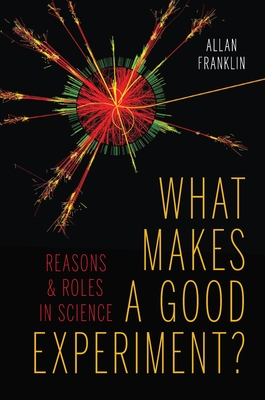
What Makes a Good Experiment?: Reasons and Roles in Science
| AUTHOR | Franklin, Allan |
| PUBLISHER | University of Pittsburgh Press (05/03/2016) |
| PRODUCT TYPE | Hardcover (Hardcover) |
Description
What makes a good experiment? Although experimental evidence plays an essential role in science, as Franklin argues, there is no algorithm or simple set of criteria for ranking or evaluating good experiments, and therefore no definitive answer to the question. Experiments can, in fact, be good in any number of ways: conceptually good, methodologically good, technically good, and pedagogically important. And perfection is not a requirement: even experiments with incorrect results can be good, though they must, he argues, be methodologically good, providing good reasons for belief in their results. Franklin revisits the same important question he posed in his 1981 article in the British Journal for the Philosophy of Science, when it was generally believed that the only significant role of experiment in science was to test theories. But experiments can actually play a lot of different roles in science--they can, for example, investigate a subject for which a theory does not exist, help to articulate an existing theory, call for a new theory, or correct incorrect or misinterpreted results. This book provides details of good experiments, with examples from physics and biology, illustrating the various ways they can be good and the different roles they can play.
Show More
Product Format
Product Details
ISBN-13:
9780822944416
ISBN-10:
0822944413
Binding:
Hardback or Cased Book (Sewn)
Content Language:
English
More Product Details
Page Count:
384
Carton Quantity:
16
Product Dimensions:
6.20 x 1.30 x 9.20 inches
Weight:
1.60 pound(s)
Feature Codes:
Bibliography,
Index,
Price on Product,
Illustrated
Country of Origin:
US
Subject Information
BISAC Categories
Science | Philosophy & Social Aspects
Science | Experiments & Projects
Dewey Decimal:
507.8
Library of Congress Control Number:
2016007241
Descriptions, Reviews, Etc.
publisher marketing
What makes a good experiment? Although experimental evidence plays an essential role in science, as Franklin argues, there is no algorithm or simple set of criteria for ranking or evaluating good experiments, and therefore no definitive answer to the question. Experiments can, in fact, be good in any number of ways: conceptually good, methodologically good, technically good, and pedagogically important. And perfection is not a requirement: even experiments with incorrect results can be good, though they must, he argues, be methodologically good, providing good reasons for belief in their results. Franklin revisits the same important question he posed in his 1981 article in the British Journal for the Philosophy of Science, when it was generally believed that the only significant role of experiment in science was to test theories. But experiments can actually play a lot of different roles in science--they can, for example, investigate a subject for which a theory does not exist, help to articulate an existing theory, call for a new theory, or correct incorrect or misinterpreted results. This book provides details of good experiments, with examples from physics and biology, illustrating the various ways they can be good and the different roles they can play.
Show More
Author:
Franklin, Allan
Allan Franklin is professor in the Department of Physics at University of Colorado. He is the author of numerous books, including "Are There Really Neutrinos? An Evidential History; Selectivity and Discord: Two Problems of Experiment;" and "No Easy Answers: Science and the Pursuit of Knowledge.
"
A. W. F. Edwards was R. A. Fisher's last student. He is professor of biometry (emeritus) at Cambridge University. His work includes "Likelihood; Foundations of Mathematical Genetics; Pascal's Arithmetical Triangle: The Story of a Mathematical Idea"; and "Cogwheels of the Mind: The Story of Venn Diagrams.
"
Daniel J. Fairbanks is professor of plant and wildlife sciences and dean of undergraduate education at Brigham Young University. He is the author of "Relics of Eden: The Powerful Evidence of Evolution in Human DNA" and coauthor of "Genetics: The Continuity of Life,"
Daniel L. Hartl is Higgins Professor of Biology in the Department of Organismic and Evolutionary Biology at Harvard University. He has authored or coauthored twenty books including "Human Genetics; Principles of Population Genetics; Primer of Population Genetics; Genetics: Analysis of Genes and Genomes; "and "Essential Genetics: A Genomics Perspective."
Teddy Seidenfeld is H. A. Simon Professor of Philosophy and Statistics in the Department of Philosophy at Carnegie Mellon University. He is coauthor of "Rethinking the Foundations of Statistics."
"
A. W. F. Edwards was R. A. Fisher's last student. He is professor of biometry (emeritus) at Cambridge University. His work includes "Likelihood; Foundations of Mathematical Genetics; Pascal's Arithmetical Triangle: The Story of a Mathematical Idea"; and "Cogwheels of the Mind: The Story of Venn Diagrams.
"
Daniel J. Fairbanks is professor of plant and wildlife sciences and dean of undergraduate education at Brigham Young University. He is the author of "Relics of Eden: The Powerful Evidence of Evolution in Human DNA" and coauthor of "Genetics: The Continuity of Life,"
Daniel L. Hartl is Higgins Professor of Biology in the Department of Organismic and Evolutionary Biology at Harvard University. He has authored or coauthored twenty books including "Human Genetics; Principles of Population Genetics; Primer of Population Genetics; Genetics: Analysis of Genes and Genomes; "and "Essential Genetics: A Genomics Perspective."
Teddy Seidenfeld is H. A. Simon Professor of Philosophy and Statistics in the Department of Philosophy at Carnegie Mellon University. He is coauthor of "Rethinking the Foundations of Statistics."
Show More
List Price $60.00
Your Price
$59.40