
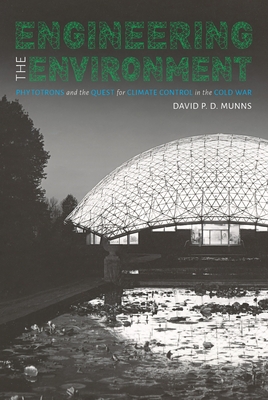
Engineering the Environment: Phytotrons and the Quest for Climate Control in the Cold War
| AUTHOR | Munns, David P. D. |
| PUBLISHER | University of Pittsburgh Press (05/14/2017) |
| PRODUCT TYPE | Hardcover (Hardcover) |
Description
Promising an end to global hunger and political instability, huge climate-controlled laboratories known as phytotrons spread around the world to thirty countries after the Second World War. The United States built nearly a dozen, including the first at Caltech in 1949. Made possible by computers and other novel greenhouse technologies of the early Cold War, phytotrons enabled plant scientists to experiment on the environmental causes of growth and development of living organisms. Subsequently, they turned biologists into technologists who, in their pursuit of knowledge about plants, also set out to master the machines that controlled their environment. Engineering the Environment tells the forgotten story of a research program that revealed the shape of the environment, the limits of growth and development, and the limits of human control over complex technological systems. As support and funding for basic science dwindled in the mid-1960s, phytotrons declined and ultimately disappeared--until, nearly thirty years later, the British built the Ecotron to study the impact of climate change on biological communities. By revisiting this history of phytotrons, David Munns reminds us of the vital role they can play in helping researchers unravel the complexities of natural ecosystems in the Anthropocene.
Show More
Product Format
Product Details
ISBN-13:
9780822944744
ISBN-10:
082294474X
Binding:
Hardback or Cased Book (Sewn)
Content Language:
English
More Product Details
Page Count:
384
Carton Quantity:
20
Product Dimensions:
6.20 x 1.20 x 9.30 inches
Weight:
1.50 pound(s)
Feature Codes:
Bibliography,
Index,
Price on Product,
Illustrated
Country of Origin:
US
Subject Information
BISAC Categories
Science | History
Science | Life Sciences - Botany
Science | History
Dewey Decimal:
581.072
Library of Congress Control Number:
2017014496
Descriptions, Reviews, Etc.
publisher marketing
Promising an end to global hunger and political instability, huge climate-controlled laboratories known as phytotrons spread around the world to thirty countries after the Second World War. The United States built nearly a dozen, including the first at Caltech in 1949. Made possible by computers and other novel greenhouse technologies of the early Cold War, phytotrons enabled plant scientists to experiment on the environmental causes of growth and development of living organisms. Subsequently, they turned biologists into technologists who, in their pursuit of knowledge about plants, also set out to master the machines that controlled their environment. Engineering the Environment tells the forgotten story of a research program that revealed the shape of the environment, the limits of growth and development, and the limits of human control over complex technological systems. As support and funding for basic science dwindled in the mid-1960s, phytotrons declined and ultimately disappeared--until, nearly thirty years later, the British built the Ecotron to study the impact of climate change on biological communities. By revisiting this history of phytotrons, David Munns reminds us of the vital role they can play in helping researchers unravel the complexities of natural ecosystems in the Anthropocene.
Show More
List Price $60.00
Your Price
$59.40