
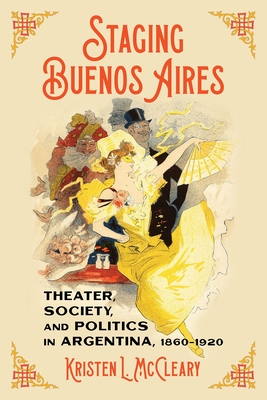
Staging Buenos Aires: Theater, Society, and Politics in Argentina, 1860-1920
| AUTHOR | McCleary, Kristen L.; McCleary, Kristen L.; McCleary, Kristen L. et al. |
| PUBLISHER | University of Pittsburgh Press (06/11/2024) |
| PRODUCT TYPE | Hardcover (Hardcover) |
Description
Staging Buenos Aires centers theater as a source of historical inquiry to understand how nonelites experienced and shaped a city undergoing dramatic transformations. Commercial theater constituted the core of the city's public sphere, one in which middle-class playwrights and audiences assumed the leading role. Audiences and critics often disagreed about what was "acceptable" entertainment. Playwrights used theater to promote their own ideas of sociopolitical change, creating a space for working- and middle-class audiences to identify and push back against imposed regulations and attitudes. Cultural production on the city's stages revealed fissures and social anxieties about the expansion of the political system and of the public sphere as women became increasingly visible in urban spaces. At the same time, theater also gave structure and meaning to these rapid changes, providing the space for the city's playwrights and complex publics to play a key role in identifying, processing, and shaping the transforming nation. Plays helped audience members work through dramatic shifts in societal norms as urbanization and industrialization resulted in the visible decline of patriarchal social structures, made most visible in the urban sphere.
Show More
Product Format
Product Details
ISBN-13:
9780822948247
ISBN-10:
0822948249
Binding:
Hardback or Cased Book (Sewn)
Content Language:
English
More Product Details
Page Count:
320
Carton Quantity:
24
Product Dimensions:
5.60 x 1.40 x 8.60 inches
Weight:
1.50 pound(s)
Country of Origin:
US
Subject Information
BISAC Categories
History | Latin America - South America
History | Theater - History & Criticism
Descriptions, Reviews, Etc.
publisher marketing
Staging Buenos Aires centers theater as a source of historical inquiry to understand how nonelites experienced and shaped a city undergoing dramatic transformations. Commercial theater constituted the core of the city's public sphere, one in which middle-class playwrights and audiences assumed the leading role. Audiences and critics often disagreed about what was "acceptable" entertainment. Playwrights used theater to promote their own ideas of sociopolitical change, creating a space for working- and middle-class audiences to identify and push back against imposed regulations and attitudes. Cultural production on the city's stages revealed fissures and social anxieties about the expansion of the political system and of the public sphere as women became increasingly visible in urban spaces. At the same time, theater also gave structure and meaning to these rapid changes, providing the space for the city's playwrights and complex publics to play a key role in identifying, processing, and shaping the transforming nation. Plays helped audience members work through dramatic shifts in societal norms as urbanization and industrialization resulted in the visible decline of patriarchal social structures, made most visible in the urban sphere.
Show More
List Price $60.00
Your Price
$59.40