
ISBN 9780826218629 is out of print and is currently unavailable, alternate formats (if applicable) are shown below.
Available options are listed below:
Available options are listed below:
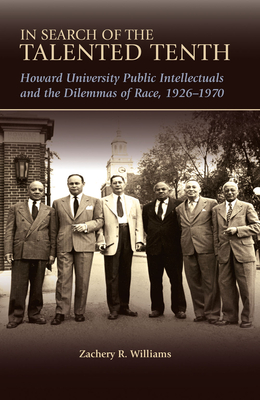
In Search of the Talented Tenth: Howard University Public Intellectuals and the Dilemmas of Race, 1926-1970 Volume 1 (Out of print)
| AUTHOR | Williams, Zachery R. |
| PUBLISHER | University of Missouri Press (01/29/2010) |
| PRODUCT TYPE | Hardcover (Hardcover) |
Description
From the 1920s through the 1970s, Howard University was home to America's most renowned assemblage of black scholars. This book traces some of the personal and professional activities of this community of public intellectuals, demonstrating their scholar-activist nature and the myriad ways they influenced modern African American, African, and Africana policy studies.
In Search of the Talented Tenth tells how individuals like Rayford Logan, E. Franklin Frazier, John Hope Franklin, Merze Tate, Charles Wesley, and Dorothy Porter left an indelible imprint on academia and black communities alike through their impact on civil rights, anticolonialism, and women's rights. Zachery Williams explores W. E. B. Du Bois's Talented Tenth by describing the role of public intellectuals from the Harlem Renaissance to the Black Power movement, in times as trying as the Jim Crow and Cold War eras.
Williams first describes how the years 1890 to 1926 laid the foundation for Howard's emergence as the "capstone of Negro education" during the administration of university president Mordecai Johnson. He offers a wide-ranging discussion of how the African American community of Washington, D.C., contributed to the dynamism and intellectual life of the university, and he delineates the ties that linked many faculty members to one another in ways that energized their intellectual growth and productivity as scholars. He also discusses the interaction of Howard's intellectual community with those of the West Indies, Africa, and other places, showing the international impact of Howard's intellectuals and the ways in which black and brown elites outside the United States stimulated the thought and scholarship of the Howard intellectuals.
In Search of the Talented Tenth marks the first in-depth study of the intellectual activity of this community of scholars and further attests to the historic role of women faculty in shaping the university. It testifies to the impact of this group as a model against which the twenty-first century's black public intellectuals can be measured.
In Search of the Talented Tenth tells how individuals like Rayford Logan, E. Franklin Frazier, John Hope Franklin, Merze Tate, Charles Wesley, and Dorothy Porter left an indelible imprint on academia and black communities alike through their impact on civil rights, anticolonialism, and women's rights. Zachery Williams explores W. E. B. Du Bois's Talented Tenth by describing the role of public intellectuals from the Harlem Renaissance to the Black Power movement, in times as trying as the Jim Crow and Cold War eras.
Williams first describes how the years 1890 to 1926 laid the foundation for Howard's emergence as the "capstone of Negro education" during the administration of university president Mordecai Johnson. He offers a wide-ranging discussion of how the African American community of Washington, D.C., contributed to the dynamism and intellectual life of the university, and he delineates the ties that linked many faculty members to one another in ways that energized their intellectual growth and productivity as scholars. He also discusses the interaction of Howard's intellectual community with those of the West Indies, Africa, and other places, showing the international impact of Howard's intellectuals and the ways in which black and brown elites outside the United States stimulated the thought and scholarship of the Howard intellectuals.
In Search of the Talented Tenth marks the first in-depth study of the intellectual activity of this community of scholars and further attests to the historic role of women faculty in shaping the university. It testifies to the impact of this group as a model against which the twenty-first century's black public intellectuals can be measured.
Show More
Product Format
Product Details
ISBN-13:
9780826218629
ISBN-10:
0826218628
Binding:
Hardback or Cased Book (Sewn)
Content Language:
English
More Product Details
Page Count:
264
Carton Quantity:
24
Product Dimensions:
6.62 x 1.01 x 9.54 inches
Weight:
1.17 pound(s)
Feature Codes:
Bibliography,
Index,
Dust Cover,
Price on Product,
Table of Contents,
Illustrated
Country of Origin:
US
Subject Information
BISAC Categories
Education | History
Education | Schools - Levels - Higher
Education | Ethnic Studies - American - African American & Black Studies
Grade Level:
College Freshman
- 5th Grade
Dewey Decimal:
378.753
Library of Congress Control Number:
2009028225
Descriptions, Reviews, Etc.
publisher marketing
From the 1920s through the 1970s, Howard University was home to America's most renowned assemblage of black scholars. This book traces some of the personal and professional activities of this community of public intellectuals, demonstrating their scholar-activist nature and the myriad ways they influenced modern African American, African, and Africana policy studies.
In Search of the Talented Tenth tells how individuals like Rayford Logan, E. Franklin Frazier, John Hope Franklin, Merze Tate, Charles Wesley, and Dorothy Porter left an indelible imprint on academia and black communities alike through their impact on civil rights, anticolonialism, and women's rights. Zachery Williams explores W. E. B. Du Bois's Talented Tenth by describing the role of public intellectuals from the Harlem Renaissance to the Black Power movement, in times as trying as the Jim Crow and Cold War eras.
Williams first describes how the years 1890 to 1926 laid the foundation for Howard's emergence as the "capstone of Negro education" during the administration of university president Mordecai Johnson. He offers a wide-ranging discussion of how the African American community of Washington, D.C., contributed to the dynamism and intellectual life of the university, and he delineates the ties that linked many faculty members to one another in ways that energized their intellectual growth and productivity as scholars. He also discusses the interaction of Howard's intellectual community with those of the West Indies, Africa, and other places, showing the international impact of Howard's intellectuals and the ways in which black and brown elites outside the United States stimulated the thought and scholarship of the Howard intellectuals.
In Search of the Talented Tenth marks the first in-depth study of the intellectual activity of this community of scholars and further attests to the historic role of women faculty in shaping the university. It testifies to the impact of this group as a model against which the twenty-first century's black public intellectuals can be measured.
In Search of the Talented Tenth tells how individuals like Rayford Logan, E. Franklin Frazier, John Hope Franklin, Merze Tate, Charles Wesley, and Dorothy Porter left an indelible imprint on academia and black communities alike through their impact on civil rights, anticolonialism, and women's rights. Zachery Williams explores W. E. B. Du Bois's Talented Tenth by describing the role of public intellectuals from the Harlem Renaissance to the Black Power movement, in times as trying as the Jim Crow and Cold War eras.
Williams first describes how the years 1890 to 1926 laid the foundation for Howard's emergence as the "capstone of Negro education" during the administration of university president Mordecai Johnson. He offers a wide-ranging discussion of how the African American community of Washington, D.C., contributed to the dynamism and intellectual life of the university, and he delineates the ties that linked many faculty members to one another in ways that energized their intellectual growth and productivity as scholars. He also discusses the interaction of Howard's intellectual community with those of the West Indies, Africa, and other places, showing the international impact of Howard's intellectuals and the ways in which black and brown elites outside the United States stimulated the thought and scholarship of the Howard intellectuals.
In Search of the Talented Tenth marks the first in-depth study of the intellectual activity of this community of scholars and further attests to the historic role of women faculty in shaping the university. It testifies to the impact of this group as a model against which the twenty-first century's black public intellectuals can be measured.
Show More
Your Price
$39.55