
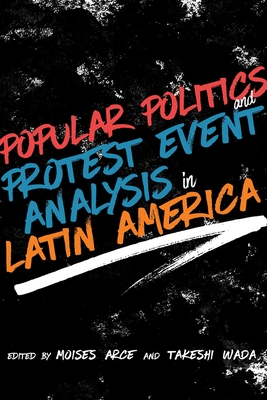
Popular Politics and Protest Event Analysis in Latin America
| AUTHOR | Arce, Moisés; Arce, Moisés; Wada, Takeshi |
| PUBLISHER | Unm Press (04/01/2024) |
| PRODUCT TYPE | Hardcover (Hardcover) |
Description
The arrival of democracy and globalization was a watershed moment for Latin America. It produced a changing political and economic environment, where democracy provided challengers with expanding political opportunities but globalization precipitated economic threats to livelihoods and human welfare. This changing environment removed the state from modes of political representation, such as urban labor movements and their affiliated mass-party organizations, while unleashing more pluralistic, heterogenous, and decentralized patterns of popular representation. Reducing its role in production, the state became mostly a regulator of economic activities. Arce and Wada's volume examines the consequences of democracy and globalization on popular protests in Latin America, theorizing a broad shift of popular politics involving reactive and proactive mobilizations. A collaboration of sixteen distinguished scholars with different specializations (economists, historians, sociologists, and political scientists) in both the Global North and South, the volume provides a unique collection of studies of protest events in ten Latin American countries: Bolivia, Brazil, Chile, Colombia, Costa Rica, Ecuador, Mexico, Nicaragua, Peru, and Venezuela.
Show More
Product Format
Product Details
ISBN-13:
9780826365682
ISBN-10:
082636568X
Binding:
Hardback or Cased Book (Sewn)
Content Language:
English
More Product Details
Page Count:
352
Carton Quantity:
16
Product Dimensions:
6.00 x 1.00 x 9.00 inches
Weight:
1.61 pound(s)
Country of Origin:
US
Subject Information
BISAC Categories
Political Science | World - Caribbean & Latin American
Political Science | Sociology - General
Political Science | Political Freedom
Descriptions, Reviews, Etc.
publisher marketing
The arrival of democracy and globalization was a watershed moment for Latin America. It produced a changing political and economic environment, where democracy provided challengers with expanding political opportunities but globalization precipitated economic threats to livelihoods and human welfare. This changing environment removed the state from modes of political representation, such as urban labor movements and their affiliated mass-party organizations, while unleashing more pluralistic, heterogenous, and decentralized patterns of popular representation. Reducing its role in production, the state became mostly a regulator of economic activities. Arce and Wada's volume examines the consequences of democracy and globalization on popular protests in Latin America, theorizing a broad shift of popular politics involving reactive and proactive mobilizations. A collaboration of sixteen distinguished scholars with different specializations (economists, historians, sociologists, and political scientists) in both the Global North and South, the volume provides a unique collection of studies of protest events in ten Latin American countries: Bolivia, Brazil, Chile, Colombia, Costa Rica, Ecuador, Mexico, Nicaragua, Peru, and Venezuela.
Show More
Your Price
$74.25