
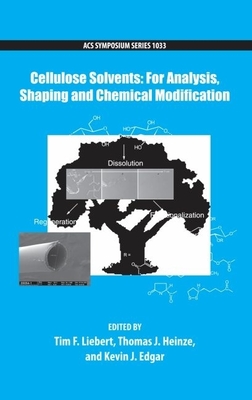
Cellulose Solvents Acsss 1033 C
| AUTHOR | Edgar, Kevin; Heinze, Thomas; Liebert, Tim et al. |
| PUBLISHER | Academic (08/25/2010) |
| PRODUCT TYPE | Hardcover (Hardcover) |
Description
The book gives an overview of the current state-of-the-art concerning the activation and dissolution of cellulose in a broad variety of solvents. Research on this topic can lead to new pathways for the utilization of the most abundant terrestrial biomolecule and may therefore be the basis for new green strategies towards advanced materials. Leading scientists in the field show different conceptions for the solubilization of cellulose. The long history and groundbreaking developments in the field of polymer chemistry, which are related to this subject, have lead to timely alternatives to already established methods. In addition to discussing attempts for the optimization of known dissolving procedures, this book also details new solvent systems. New solvents include inorganic and organic salt melts (ionic liquids), new aqueous media, multi-component organic solvents and the dissolution under partial derivatization of the polysaccharide. The opportunities and the limitations of the solvents are demonstrated, with a particular emphasis on the stability of the solutions and a possible recycling of the solvent components. This book illustrates that the new procedures for cellulose dissolution can lead to a huge number of unconventional superstructures of regenerated cellulose material, such as fibers and polymer layers with a thickness in the nanometer range or aerogels, i.e. regenerates with a highly porous character and a large surface. Moreover, cellulose blends can be generated via solutions. The book also contains chapters that show the amazing potential of solvents for defined modification reactions on the cellulose backbone. On one hand, it is possible to synthesize known cellulose derivatives with new substitution patterns both on the basis of the repeating unit and along the polymer chain. On the other hand, completely new derivatives are presented which are hardly accessible via heterogeneous reactions. Consequently, the book is intended to give a comprehensive overview of procedures for dissolution of cellulose. It is of interest for scientists new in the field but is also a timely summary of trends for experts who are looking for new approaches for problems related to cellulose shaping or chemical modification.
Show More
Product Format
Product Details
ISBN-13:
9780841200067
ISBN-10:
0841200068
Binding:
Hardback or Cased Book (Sewn)
Content Language:
English
More Product Details
Page Count:
424
Carton Quantity:
18
Product Dimensions:
6.14 x 0.94 x 9.21 inches
Weight:
1.68 pound(s)
Feature Codes:
Bibliography,
Index
Country of Origin:
US
Subject Information
BISAC Categories
Technology & Engineering | Chemical & Biochemical
Technology & Engineering | Textiles & Polymers
Technology & Engineering | Linguistics - General
Dewey Decimal:
661.802
Library of Congress Control Number:
2009050036
Descriptions, Reviews, Etc.
publisher marketing
The book gives an overview of the current state-of-the-art concerning the activation and dissolution of cellulose in a broad variety of solvents. Research on this topic can lead to new pathways for the utilization of the most abundant terrestrial biomolecule and may therefore be the basis for new green strategies towards advanced materials. Leading scientists in the field show different conceptions for the solubilization of cellulose. The long history and groundbreaking developments in the field of polymer chemistry, which are related to this subject, have lead to timely alternatives to already established methods. In addition to discussing attempts for the optimization of known dissolving procedures, this book also details new solvent systems. New solvents include inorganic and organic salt melts (ionic liquids), new aqueous media, multi-component organic solvents and the dissolution under partial derivatization of the polysaccharide. The opportunities and the limitations of the solvents are demonstrated, with a particular emphasis on the stability of the solutions and a possible recycling of the solvent components. This book illustrates that the new procedures for cellulose dissolution can lead to a huge number of unconventional superstructures of regenerated cellulose material, such as fibers and polymer layers with a thickness in the nanometer range or aerogels, i.e. regenerates with a highly porous character and a large surface. Moreover, cellulose blends can be generated via solutions. The book also contains chapters that show the amazing potential of solvents for defined modification reactions on the cellulose backbone. On one hand, it is possible to synthesize known cellulose derivatives with new substitution patterns both on the basis of the repeating unit and along the polymer chain. On the other hand, completely new derivatives are presented which are hardly accessible via heterogeneous reactions. Consequently, the book is intended to give a comprehensive overview of procedures for dissolution of cellulose. It is of interest for scientists new in the field but is also a timely summary of trends for experts who are looking for new approaches for problems related to cellulose shaping or chemical modification.
Show More
List Price $275.00
Your Price
$272.25