
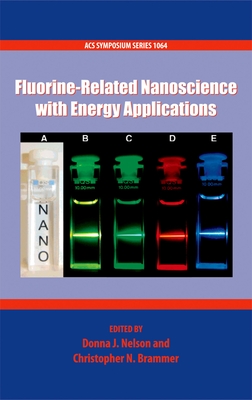
Fluorine-Related Nanoscience with Energy Applications
| AUTHOR | Brammer, Christohpher; Brammer, Christohpher; Nelson, Donna et al. |
| PUBLISHER | Academic (11/11/2011) |
| PRODUCT TYPE | Hardcover (Hardcover) |
Description
The conditions of our overpopulated planet with ever-growing energy needs, fossil fuels in limited supplies, and inefficient energy use world-wide, are creating a global crisis. Science has a responsibility, as well as a grand opportunity, to solve these energy-based problems of society. Science's new nanotechnologies, and the creativity they bring, are particularly appropriate to solve these problems. For example, energy-saving lighting, coupled with improved harvesting and conversion of sunlight into electric energy, will have a great impact on society's energy needs. Also, development of energy efficient and low cost fuel cells, which could eventually replace car engines, has a potential to improve everyday life greatly. Nanomaterials offer an opportunity to develop new low-cost materials as environmentally friendly solutions and renewable energy sources, in order to meet society's energy needs. Fortunately, a wide spectrum of the scientific community has become interested in developing these nanomaterials in order to solve the above energy challenges. Nanomaterials offer unique mechanical, catalytic, electronic, and optical features, which are different from those of the analogous bulk material (1). This is because nanomaterials have scale-dependent properties, due to quantum size effects, which means the nanomaterial size (10 - 100 nm) is smaller than the mean free path of their electrons. Thus, nanomaterials have great promise for use in harvesting solar energy, hydrogen production and storage, fuel cells, catalysis, chemical, optical sensors, drug delivery systems (such as liposomes), and nanothermite reactions (2-4). Fluorine-containing nanomaterials generally have certain unique properties which are often improved relative to the analogous non-fluorinated nanomaterials, and which therefore could be engineered. Although fluorine has the highest electronegativity of all the elements, which means that bonds to fluorine are generally quite polar, it is also in the second period of the periodic table, so it also has a small atomic radius and forms strong bonds. This produces the following properties, which also are characteristic of and bring great advantages to fluorine nanomaterials: high thermal and chemical stability, resistance to degradation by solvents, low flammability, low moisture absorption, low surface tension or energy, low dielectric constant, and serving as a strong oxidant under high energy conditions (5). However, little attention has been given to fluorine-containing organic and inorganic nanomaterials, which are predicted to have these unusual characteristics. This book presents examples of four diverse classes of these nanomaterials.
Show More
Product Format
Product Details
ISBN-13:
9780841226104
ISBN-10:
0841226105
Binding:
Hardback or Cased Book (Sewn)
Content Language:
English
More Product Details
Page Count:
182
Carton Quantity:
34
Product Dimensions:
6.14 x 0.50 x 9.21 inches
Weight:
0.96 pound(s)
Feature Codes:
Bibliography,
Index,
Illustrated
Country of Origin:
US
Subject Information
BISAC Categories
Science | Chemistry - Inorganic
Science | Chemistry - Industrial & Technical
Dewey Decimal:
546.731
Library of Congress Control Number:
2011013621
Descriptions, Reviews, Etc.
publisher marketing
The conditions of our overpopulated planet with ever-growing energy needs, fossil fuels in limited supplies, and inefficient energy use world-wide, are creating a global crisis. Science has a responsibility, as well as a grand opportunity, to solve these energy-based problems of society. Science's new nanotechnologies, and the creativity they bring, are particularly appropriate to solve these problems. For example, energy-saving lighting, coupled with improved harvesting and conversion of sunlight into electric energy, will have a great impact on society's energy needs. Also, development of energy efficient and low cost fuel cells, which could eventually replace car engines, has a potential to improve everyday life greatly. Nanomaterials offer an opportunity to develop new low-cost materials as environmentally friendly solutions and renewable energy sources, in order to meet society's energy needs. Fortunately, a wide spectrum of the scientific community has become interested in developing these nanomaterials in order to solve the above energy challenges. Nanomaterials offer unique mechanical, catalytic, electronic, and optical features, which are different from those of the analogous bulk material (1). This is because nanomaterials have scale-dependent properties, due to quantum size effects, which means the nanomaterial size (10 - 100 nm) is smaller than the mean free path of their electrons. Thus, nanomaterials have great promise for use in harvesting solar energy, hydrogen production and storage, fuel cells, catalysis, chemical, optical sensors, drug delivery systems (such as liposomes), and nanothermite reactions (2-4). Fluorine-containing nanomaterials generally have certain unique properties which are often improved relative to the analogous non-fluorinated nanomaterials, and which therefore could be engineered. Although fluorine has the highest electronegativity of all the elements, which means that bonds to fluorine are generally quite polar, it is also in the second period of the periodic table, so it also has a small atomic radius and forms strong bonds. This produces the following properties, which also are characteristic of and bring great advantages to fluorine nanomaterials: high thermal and chemical stability, resistance to degradation by solvents, low flammability, low moisture absorption, low surface tension or energy, low dielectric constant, and serving as a strong oxidant under high energy conditions (5). However, little attention has been given to fluorine-containing organic and inorganic nanomaterials, which are predicted to have these unusual characteristics. This book presents examples of four diverse classes of these nanomaterials.
Show More
List Price $110.00
Your Price
$108.90