
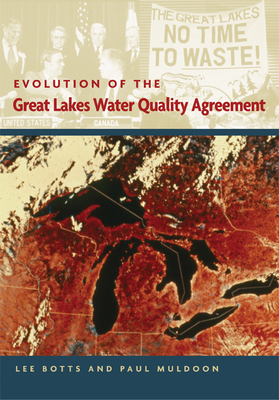
Evolution of the Great Lakes Water Quality Agreement
| AUTHOR | Botts, Lee; Muldoon, Paul |
| PUBLISHER | Michigan State University Press (11/08/2005) |
| PRODUCT TYPE | Paperback (Paperback) |
Water quality concerns are not new to the Great Lakes. They emerged early in the 20th century, in 1909, and matured in 1972 and 1978. They remain a prominent part of today's conflicted politics and advancing industrial growth. The Great Lakes Water Quality Agreement, under the Boundary Waters Treaty of 1909, became a model to the world for environmental management across an international boundary. Evolution of the Great Lakes Water Quality Agreement recounts this historic binational relationship, an agreement intended to protect the fragile Great Lakes.
One strength of the agreement is its flexibility, which includes a requirement for periodic review that allows modification as problems are solved, conditions change, or scientific research reveals new problems. The first progress was made in the 1970s in the area of eutrophication, the process by which lakes gradually age, which normally takes thousands of years to progress, but is accelerated by modern water pollution. The binational agreement led to the successful lowering of phosphorus levels that saved Lake Erie and prevented accelerated eutrophication in the rest of the Great Lakes ecosystem. Another major success at the time was the identification and lowering of the levels of toxic contaminants that cause major threats to human and wildlife health, from accumulating PCBs and other persistent organic pollutants
Water quality concerns are not new to the Great Lakes. They emerged early in the 20th century, in 1909, and matured in 1972 and 1978. They remain a prominent part of today's conflicted politics and advancing industrial growth. The Great Lakes Water Quality Agreement, under the Boundary Waters Treaty of 1909, became a model to the world for environmental management across an international boundary. Evolution of the Great Lakes Water Quality Agreement recounts this historic binational relationship, an agreement intended to protect the fragile Great Lakes.
One strength of the agreement is its flexibility, which includes a requirement for periodic review that allows modification as problems are solved, conditions change, or scientific research reveals new problems. The first progress was made in the 1970s in the area of eutrophication, the process by which lakes gradually age, which normally takes thousands of years to progress, but is accelerated by modern water pollution. The binational agreement led to the successful lowering of phosphorus levels that saved Lake Erie and prevented accelerated eutrophication in the rest of the Great Lakes ecosystem. Another major success at the time was the identification and lowering of the levels of toxic contaminants that cause major threats to human and wildlife health, from accumulating PCBs and other persistent organic pollutants