
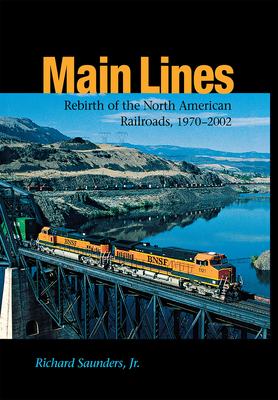
Main Lines: Rebirth of the North American Railroads, 1970-2002
| AUTHOR | Saunders, Richard, Jr.; Saunders, Richard, Jr.; Saunders, Richard, Jr. et al. |
| PUBLISHER | Northern Illinois University Press (10/09/2003) |
| PRODUCT TYPE | Hardcover (Hardcover) |
Rising from the corporate wreckage of the 1970s, when even the nation's largest railroad filed for bankruptcy, American railroads are once again a major part of the global economy. Richard Saunders brings to life this amazing story of revitalization, showing how a combination of creatively structured aid from the public sector and talented private management gave railroads new momentum. By 2002, American railroads carried five times the tonnage they hauled in their former heyday, and they did this with one-tenth of the employees.
How did this revolution happen? Saunders shows how limited, disciplined, and politically risky government intervention stabilized a sinking industry. Whatever their results for other industries, President Carter's deregulation and President Reagan's tax revisions restored the railroads' financial health. Container cars and other new technologies also helped to transform inefficient railroads into vibrant enterprises. Corporate strategies varied on the road to success, and even skilled managers encountered pitfalls, but the railroads' resurgence and growth proved to be unstoppable.
After the merger mania of the mid-twentieth century, the main U.S. railroad systems evolved into seven transregional corporate giants. Of the "Super Seven," only four survived past the 1990s--the Norfolk Southern, CSX, Union Pacific, and Burlington Northern-Santa Fe. These four set the standard at a time when no other major railroads could afford the new technologies needed to turn a profit.
A sequel to Merging Lines, this engagingly written account brings the story of American railroads up to the twenty-first century. As American transport enters the twenty-first century, the iron horse that consolidated the Industrial Revolution once again flexes its muscle.
Rising from the corporate wreckage of the 1970s, when even the nation's largest railroad filed for bankruptcy, American railroads are once again a major part of the global economy. Richard Saunders brings to life this amazing story of revitalization, showing how a combination of creatively structured aid from the public sector and talented private management gave railroads new momentum. By 2002, American railroads carried five times the tonnage they hauled in their former heyday, and they did this with one-tenth of the employees.
How did this revolution happen? Saunders shows how limited, disciplined, and politically risky government intervention stabilized a sinking industry. Whatever their results for other industries, President Carter's deregulation and President Reagan's tax revisions restored the railroads' financial health. Container cars and other new technologies also helped to transform inefficient railroads into vibrant enterprises. Corporate strategies varied on the road to success, and even skilled managers encountered pitfalls, but the railroads' resurgence and growth proved to be unstoppable.
After the merger mania of the mid-twentieth century, the main U.S. railroad systems evolved into seven transregional corporate giants. Of the "Super Seven," only four survived past the 1990s--the Norfolk Southern, CSX, Union Pacific, and Burlington Northern-Santa Fe. These four set the standard at a time when no other major railroads could afford the new technologies needed to turn a profit.
A sequel to Merging Lines, this engagingly written account brings the story of American railroads up to the twenty-first century. As American transport enters the twenty-first century, the iron horse that consolidated the Industrial Revolution once again flexes its muscle.