
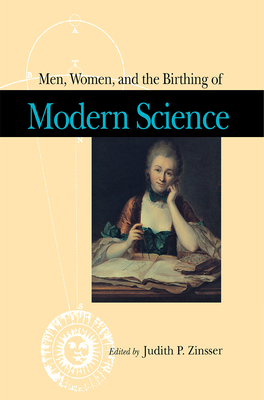
Men, Women, and the Birthing of Modern Science
| PUBLISHER | Northern Illinois University Press (08/10/2005) |
| PRODUCT TYPE | Hardcover (Hardcover) |
In the early 1600s, Francis Bacon could encompass all knowledge of both the physical and the metaphysical in a single term: natural philosophy. Over the next two hundred years, however, natural philosophy gradually split into philosophy--the study of first causes and ways of knowing--and science--the study of the material world, based on direct observation and verifiable experiment.
Science was not initially an exclusively masculine domain. During the seventeenth and eighteenth centuries, women received doctorates in physics and taught at universities. They corresponded with Descartes and dared to question his premises and conclusions. In astronomy, they worked side-by-side with men to make observations and calculate cometary orbits. They not only translated and illustrated scientific works but published original syntheses and reports based on their own research. Gradually, however, as access to the new knowledge became institutionalized, women were excluded, and by the beginning of the nineteenth century, the roles open to women were deemed secondary to those of men. Women s ideas or discoveries were subsumed under the names of male colleagues, dismissed as the work of amateurs, or viewed as marginal and easily forgotten. This subtle combination of changed circumstances gave the new science a gendered dimension. Men, Women, and the Birthing of Modern Science traces the division of natural philosophy into the modern categories of philosophy and science and the gradual marginalization of women as intellectuals. Here, ten scholars of gender, women s history, and the history of philosophy and science write on these twin themes, allowing the opportunity for cross-cultural analysis and yielding insights into the history of both science and women.In the early 1600s, Francis Bacon could encompass all knowledge of both the physical and the metaphysical in a single term: natural philosophy. Over the next two hundred years, however, natural philosophy gradually split into philosophy--the study of first causes and ways of knowing--and science--the study of the material world, based on direct observation and verifiable experiment.
Science was not initially an exclusively masculine domain. During the seventeenth and eighteenth centuries, women received doctorates in physics and taught at universities. They corresponded with Descartes and dared to question his premises and conclusions. In astronomy, they worked side-by-side with men to make observations and calculate cometary orbits. They not only translated and illustrated scientific works but published original syntheses and reports based on their own research. Gradually, however, as access to the new knowledge became institutionalized, women were excluded, and by the beginning of the nineteenth century, the roles open to women were deemed secondary to those of men. Women s ideas or discoveries were subsumed under the names of male colleagues, dismissed as the work of amateurs, or viewed as marginal and easily forgotten. This subtle combination of changed circumstances gave the new science a gendered dimension. Men, Women, and the Birthing of Modern Science traces the division of natural philosophy into the modern categories of philosophy and science and the gradual marginalization of women as intellectuals. Here, ten scholars of gender, women s history, and the history of philosophy and science write on these twin themes, allowing the opportunity for cross-cultural analysis and yielding insights into the history of both science and women.