
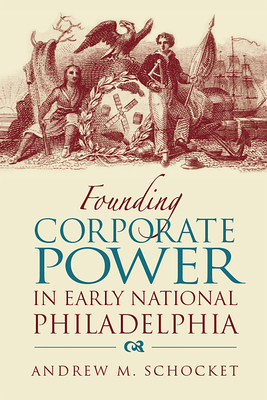
Founding Corporate Power in Early National Philadelphia
| AUTHOR | Schocket, Andrew; Schocket, Andrew; Schocket, Andrew et al. |
| PUBLISHER | Northern Illinois University Press (01/16/2007) |
| PRODUCT TYPE | Hardcover (Hardcover) |
During its first heady decades, the United States promised to become a fully democratic society with unprecedented liberty and opportunity. Yet, as political rights spread, a rising elite gained control over the sources of prosperity by means of the institution that has since come to symbolize capitalist America--the corporation. In this study, Andrew M. Schocket analyzes the establishment, growth, and operations of both commercial and municipal corporations in the nation s premier city, Philadelphia.
From the 1780s through the 1820s, members of Philadelphia s privileged class formed corporations in order to consolidate their capital and political influence. By controlling regional transportation networks as well as banks and the municipal water supply, they exploited the ambitions of local farmers, artisans, and entrepreneurs who depended upon corporate services. Meanwhile, corporate insiders managed to insulate their decision making not only from the public but even from the majority of their own stockholders. In short, in this leading commercial city with a reputation for innovation, a corporate aristocracy created a new form of power. At the same time, corporations answered needs that private individuals or partnerships could not--and government, uncertain of its own authority, would not--supply. Resolving the apparent contradiction between the spread of political democracy and the consolidation of economic power, Schocket provocatively argues that corporations helped to generate the relatively diffuse prosperity of the early national period. Though controlled by the few, they offered services that allowed middle-class entrepreneurs to flourish. This mixed legacy has resulted in the continuing ambivalence toward U.S. corporations today.During its first heady decades, the United States promised to become a fully democratic society with unprecedented liberty and opportunity. Yet, as political rights spread, a rising elite gained control over the sources of prosperity by means of the institution that has since come to symbolize capitalist America--the corporation. In this study, Andrew M. Schocket analyzes the establishment, growth, and operations of both commercial and municipal corporations in the nation s premier city, Philadelphia.
From the 1780s through the 1820s, members of Philadelphia s privileged class formed corporations in order to consolidate their capital and political influence. By controlling regional transportation networks as well as banks and the municipal water supply, they exploited the ambitions of local farmers, artisans, and entrepreneurs who depended upon corporate services. Meanwhile, corporate insiders managed to insulate their decision making not only from the public but even from the majority of their own stockholders. In short, in this leading commercial city with a reputation for innovation, a corporate aristocracy created a new form of power. At the same time, corporations answered needs that private individuals or partnerships could not--and government, uncertain of its own authority, would not--supply. Resolving the apparent contradiction between the spread of political democracy and the consolidation of economic power, Schocket provocatively argues that corporations helped to generate the relatively diffuse prosperity of the early national period. Though controlled by the few, they offered services that allowed middle-class entrepreneurs to flourish. This mixed legacy has resulted in the continuing ambivalence toward U.S. corporations today.